Showing posts with label News. Show all posts

Casio Pathfinder PAG-240

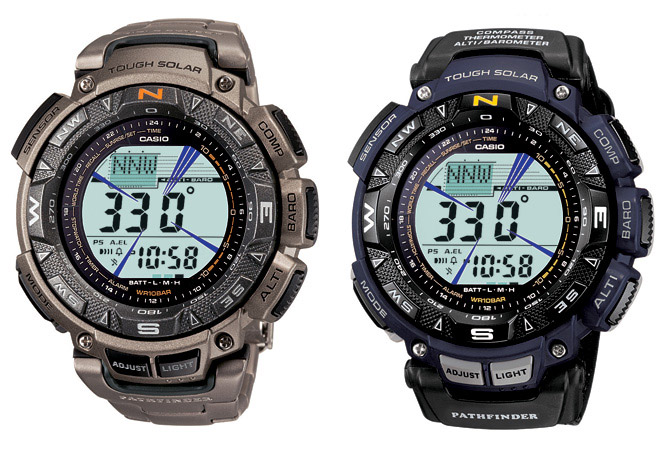
Casio recently updated their mid-range Pathfinder lineup — the "Solar Triple Sensor" line — by adding the PAG-240 which sports a series of refinements. The Pathfinder line is famous for melding large LCD screens with navigational and atmospheric data, all in a wrist-top package. The Casio PAG-240 uses a new duplex screen, and a new manner of navigating its many features.

  • Plastic resin case
  • 51 x 15.5mm, 65g
  • Casio 3246 movement (+/- 15 seconds)
  • Solar powered
  • Compass
  • Altimeter
  • Barometer
  • Thermometer
  • Sunrise/sunset timer
  • Duplex LCD (two layers)
  • Countdown timer
  • World time
  • Automatic Calendar
  • Auto back-light with afterglow feature
  • Resin strap
  • Retail price of $250
This mid range Pathfinder sports most of what the higher end models have but, omits the radio synchronization for timekeeping. This allows the 240 to come in at a lower price but still offers much of the feature set available in the higher end models.

Casio has refined the PAG-240 with a new duplex screen which incorporates the main screen and an additional layer of "lines" on top. These lines can display an additional time zone, compass information, sunrise and sunset, or help you cycle through the menus. The new menu navigation is possibly the best feature of the PAG-240; as you cycle through the modes the duplex screen indicates what mode you are currently in — a huge improvement over the previous navigation systems. Combine that with the small matrix screen at 11 o'clock, and you can get a lot of information all at once without having to keep pressing buttons (see the video review for a demonstration).

In the past, I have not been able to wear an ABC (altimeter, barometer, compass) watch full-time because I always found they were too complicated to be instantly usable, but this is not the case with the PAG-240. The PAG-240 combines useful features and an intuitive user interface into an unbelievably light package. This Pathfinder actually weighs nearly half as much as the last dive watch I bought, and feels comparatively like you're not wearing a watch at all.

Retail price for the PAG-240 is $250 which is a good price for the complete package the Casio has going with this watch.

posted under , | 0 Comments

Casio Pathfinder PRW-5000-1ER

If there's any one company that continues to innovate, it has to be Casio. Their newest Pathfinder/Protrek, the PRW-5000, takes their kitchen-sink feature list and completely rethinks to design with an emphasis on analog hands.

Let's start with the features:

  • Solar powered.
  • Atomic timekeeping, six bands: US, UK, Germany, China, Japan (2x).
  • Altimeter, barometer, compass, and thermometer.
  • World time, stopwatch, countdown timer, five alarms.
  • Low temperature resistant down to -10C.
  • Water resistant to 100m (330ft).
  • Mineral crystal, fixed stainless steel bezel.
  • Casio movement 5114 (PDF), with self-correcting hands.
  • 49mm across, 14.6mm thick, 85g on the 22mm resin strap.
  • List price of $450.
Casio completely changed the look this time, yielding a watch whose complexity is less obvious. As a fan of analog-digital watches, this instantly became my favorite Pathfinder. There are, of course, compromises with the design, so read on to see if you agree or not.

In this design, the second hand is used to replace the second LCD layer in previous designs. It acts as compass needle, barometric pressure indicator, and altimeter, with the latter two read out from the orange inset on the dial. There's a graph on the right hand side of the LCD that shows trends over time for pressure and altitude to complement the instantaneous readout. Since the LCD is smaller in size, modes and indicators are more terse ('TR' instead of 'Stopwatch', for example), so reading the manual is required to learn how to use everything.

The watch is pointing close to due north, with the LCD showing the precise reading and the second hand approximating. Note that the second hand jumps, updating once per second and indicating to the closest minute marker. This works well, but takes a bit of getting used to as it differs from a magnetic compass. Note also that the compass is disabled when the LED is on, so you can't navigate at night with it (unless you have a flashlight, which you probably will).

The altimeter and barometer mode function similarly in that the second hand indicates relative readings on the orange section of the dial from 11 to 3. You can set two scales for the altimeter, and the barometer mode is quite nice for sailors or fisherman, as changes are visible quickly. I had no problem reading time and altitude change while biking on rough ground.

In time mode, you can switch the display from day of the week to barometer graph mode on the LCD by pressing Adjust -- a nice feature that I appreciate. Each pixel shows 2 hours, giving a days' view at a glance.

Nighttime viewing is done via a blue-white LED at six o'clock. The dial is brilliantly lit, and the LCD is fairly well lit, as well. I worry about impairing night-adjusted eyes, as the light is quite bright, but otherwise it works great. I like that solar power removes any worries about running down the battery with the backlight, too. In fact, every hiking watch should be solar powered in my opinion. It's just one less thing to worry about before you set out.

StrapCase, caseback, and strap are classic Casio: simple, functional, comfortable. There's an inset metal segment that I could do without, but it does complement the design. On this model, Casio went with a stainless steel bezel with four probably-decorative screws and nice crosshatch pattern. It looks great -- more durable and nicer looking than plastic. It's even satin-finished so reflections aren't a problem.

The main appeal of the Pathfinder line is you can grab it and go on anything from a dayhike to the Appalachian trail and never worry about your watch. Durable, water resistant enough at 100m, quartz-accurate even when it can't get a radio signal, and a good backup for your primary navigation, too. They're not cheap at $450, but good outdoor gear is no place to pinch pennies.

posted under , , | 0 Comments

The Omega Speedmaster Professional

I have a thing for durable watches. Finding a watch that can stand up to an active lifestyle, and still look good and keep great time over the period of many years, is surprisingly difficult. If you want a really robust watch, the conventional wisdom is to go with a Casio G-Shock if you're looking for a quartz or digital solution, and a Rolex if you want something Swiss and high-end. But Omega fans know there's another option which has one of the most interesting backstories in the history of horology.

The Omega Speedmaster Professional lands squarely between a high-end G-Shock and sport model Rolex in terms of price, looks fantastic, and has stood up to some of the most rigorous testing that any watch has ever been subjected to. Not only have Speedmaster Pros gone into space on many occasions, but they have actually been worn outside a space suit on the surface of the moon.

Before I get into the history of the Omega Speedmaster Professional, let's cover the specs:

  • Stainless steel case and bracelet.
  • Legendary Speedmaster bracelet with push-button release.
  • Caliber 1861 manual wind movement; rhodium plated for corrosion resistance; 48-hour power reserve.
  • Hesalite crystal (a type of plastic similar to Plexiglass -- very shock resistant).
  • Water resistant to 50 meters, or 167 feet.
  • Chronograph function (with "small seconds" at the 9 o'clock position), and tachymeter.
  • 42mm case diameter.

As you can see, the Omega Speedmaster Professional isn't a fancy watch in terms of complications and features. It has to be wound manually, it doesn't have a date display, I wouldn't get it wet beyond a shower, and the crystal is relatively easily scratched. But what it does have is a combination of simplicity, build quality, and well chosen materials that make it one of the most robust and interesting watches currently on the market. Let's take a closer look.

The Bracelet

This was my first experience with the legendary "Speedy" bracelet, and I'm hooked. I've handled a lot of stainless steel bracelets over the years, but I'm pretty sure this is my favorite. It's solid, perfectly machined and built, and completely silent (no squeaks). While it's robust, it's not so massive as to be a burden or feel like an anchor. The clasp design is simple and elegant, and the polished strips that cap the center links give it just a touch of class.

The Movement

Yes, the movement has to be wound manually, and no, there's no date or day or moon phase or GMT hand, but there's something to be said for a simple design in terms of robustness. The Lemania 1861 movement has changed very little over the history of the Speedmaster, and for good reason. If it ain't broke, don't fix it. It is now rhodium plated (which is the difference between the 861 movement, and the 1861 movement) for additional corrosion resistance, but that's about it. So how does it perform by today's standards? Mine is about 1.5 seconds fast per day -- as good or better than any other mechanical watch I've ever owned, including many that cost far more.

The Crystal

Now that practically scratch-proof synthetic sapphire is the standard in high-end watches, why would anyone want a throwback to the days of plastic? Two reasons. The first is simple aesthetics. Although sapphire is far more scratch resistant, some people simply prefer the look of the Hesalite (it tends to have a look which is more functional than classy, in my opinion). And the second is that although sapphire is very scratch-resistant, it breaks relatively easily. What do I mean by "easily?" Well, don't drop a watch with a sapphire crystal on a tile floor, and if you're going to be swinging your arm around with any velocity, make sure there's no chance your watch might hit anything of any substance. While the Hesalite crystal is certain to pick up minor scratch over the years, there's not a lot you can do to it to actually break it. The other advantage to the Hesalite is that it's very easily polished if the scratches start to bother you, and relatively inexpensively replaced if you really gouge it.

Water Resistance

Now that your typical Casio G-Shock is water resistant down to 200 meters (about 660 feet) and most of the big Swiss brands have watches with screw-down crowns that are rated to 300 meters (about 1,000 feet), 600 meters (about 2,000 feet) and even 1,220 meters (4,000 feet), why would you settle for a mere 50 meters, or 167 feet? Primarily because 50 meters if perfectly sufficient for most of us. If you're a diver or even a frequent swimmer and you don't want to change your watch, the Speedmaster certainly isn't for you. But if you just want to feel confident in a rain storm, rinse your watch off when it's dirty, take the occasional shower with it on, or not have to worry about falling into a pool, then 50 meters is perfectly fine. The Speedmaster has also demonstrated more than enough water resistance to function perfectly well in very humid conditions (more on this below).

The History

So what makes the Omega Speedmaster Professional such a legend? By now, most watch aficionados know that the Speedmaster was worn on the moon, but most don't know the details behind the story.

When the Speedmaster was introduced in 1957, Omega had no intention of sending it into space, but the combination of the chronograph and the fact that it is a manual-wind watch made it a great choice during some of the Mercury missions. Astronauts needed a manual-wind watch since automatic (or "self-winding") watches rely on a weighted rotor which doesn't work well in zero gravity, and they needed a highly accurate chronograph for timing rocket firing sequences. During the Mercury missions, astronauts could wear any watch they wanted, or even no watch at all, since watches were basically backups to the onboard clocks, but during the Gemini and Apollo programs -- which involved EVAs (extravehicular activities) which needed to be timed -- the right watch became far more important.

In 1962, NASA began searching for a more official piece of timing equipment to be worn by Gemini and Apollo astronauts. Several watches were purchased over-the-counter and subjected to rigorous testing including temperatures from 0° to 200° F, 12g's of acceleration, extreme humidity, and a violent vibration test. Some of the Mercury astronauts' instincts had been spot on: the Omega Speedmaster Professional was the only one to pass all of NASA's tests. In 1965, the Speedmaster was declared the official watch of the US space program.

The Speedmaster was subsequently worn by Edward White on the first America spacewalk in 1965, Buzz Aldrin in 1969 during his and Neil Armstrong's famous first lunar excursion, and it was used by James Lovell to time various burns during the ill-fated Apollo 13 flight since the onboard clocks were inoperable.

The Omega Speedmaster thus survived some of the most rigorous testing of any watch in the world as well as the harshest environments and conditions known to man, and even several political attacks by Bulova watch company who insisted that NASA should be using American technology rather than Swiss (the Bulova watches never passed all of NASA's tests like the Speedmaster did). The Omega Speedmaster became such an important and recognizable icon of the space program that Buzz Aldrin's Speedmaster -- the first watch ever on the moon -- was tragically stolen while being transfered along with other equipment to the Smithsonian for display.

Conclusion

At this point, there are several versions of the Speedmaster available. You can now get them with Co-Axial escapements, self-winding movements, sapphire crystals with anti-reflective coatings, date and day-date complications, display casebacks, 100 meters of water resistance, GMT functionality, and all kinds of variations in hand design, case and bracelet materials, dials, and straps. But Omega has continued to offer almost the exact same watch that was chosen by NASA in 1965 which I have now chosen as my first Omega all these years later.

While there are at least eleven different Speedmasters available today, there is only one true moon watch.
posted under , | 0 Comments

Casio Pathfinder PAG-240

Casio recently updated their mid-range Pathfinder lineup -- the "Solar Triple Sensor" line -- by adding the PAG-240 which sports a series of refinements. The Pathfinder line is famous for melding large LCD screens with navigational and atmospheric data, all in a wrist-top package. The Casio PAG-240 uses a new duplex screen, and a new manner of navigating its many features.
  • Plastic resin case
  • 51 x 15.5mm, 65g
  • Casio 3246 movement (+/- 15 seconds)
  • Solar powered
  • Compass
  • Altimeter
  • Barometer
  • Thermometer
  • Sunrise/sunset timer
  • Duplex LCD (two layers)
  • Countdown timer
  • World time
  • Automatic Calendar
  • Auto back-light with afterglow feature
  • Resin strap
  • Retail price of $250
This mid range Pathfinder sports most of what the higher end models have but, omits the radio synchronization for timekeeping. This allows the 240 to come in at a lower price but still offers much of the feature set available in the higher end models.

Casio has refined the PAG-240 with a new duplex screen which incorporates the main screen and an additional layer of "lines" on top. These lines can display an additional time zone, compass information, sunrise and sunset, or help you cycle through the menus. The new menu navigation is possibly the best feature of the PAG-240; as you cycle through the modes the duplex screen indicates what mode you are currently in -- a huge improvement over the previous navigation systems. Combine that with the small matrix screen at 11 o'clock, and you can get a lot of information all at once without having to keep pressing buttons (see the video review for a demonstration).

In the past, I have not been able to wear an ABC (altimeter, barometer, compass) watch full-time because I always found they were too complicated to be instantly usable, but this is not the case with the PAG-240. The PAG-240 combines useful features and an intuitive user interface into an unbelievably light package. This Pathfinder actually weighs nearly half as much as the last dive watch I bought, and feels comparatively like you're not wearing a watch at all.

Retail price for the PAG-240 is $250 which is a good price for the complete package the Casio has going with this watch.

posted under , | 0 Comments

Rogue Warrior Red Cell GMT

Following hot on the heels of our review of the Rogue Warrior Avenger, let us introduce the Red Cell. Named after the unofficial title of Richard Marcinko's Navy security team, the Red Cell combines some interesting technology with a rough-and-tumble case and crystal guard.

Rogue Warrior is a new brand making hardcore watches for people who expect their watch to make it through just about anything. Rogue Warrior's tag line reads "When bad-ass is not bad ass enough." Is this simply marketing fluff, or is this a watch that sets a new standard in resilience?

Let's start with the specs:

  • Stainless steel case.
  • Japanese quartz movement with GMT hand.
  • 44mm wide.
  • 4mm anti-glare sapphire crystal.
  • Superluminova and Kryptolite illumination system.
  • Krypton gas filled case.
  • d3o shock absorbing system.
  • 3-year battery.
  • 20 ATM water resistance (200m/660ft).

The first thing that stands out about the Red Cell is its styling which is polarizing at best. It's definitely not a beautiful watch as the designers seemed to have made concessions in the aesthetics in attempt to make the watch as functional and resilient as possible.

The dial design is highly functional with both the standard hands and the GMT hand easily legible at a glance. The chapter ring and the GMT hand work together to keep track of a user defined timezone, and the hand is manipulated on the first pull position of the nicely knurled screw down crown.

The luminosity of the paint on the dial is excellent; Rogue Warrior uses Superluminova paint on the markers, numbers, and hands combined with Krypton gas which fills the case. The combination is called Kryptolite and allows the material to glow brightly and charge quickly. While it does work as well as the best Superluminova implementations I have seen, it does not seem to last as long as examples like the Seiko Monster -- a reasonable tradeoff, in my opinion. The Krypton gas in the case also works to prevent condensation from forming after drastic temperature or humidity changes.

The case is a stark combination of hard edges and those less-than-attractive crystal guards. When the overal goals of this watch are considered, picking on its looks begins to feel like comparing a tank to an italian sports car: they weren't designed with the same purpose (or buyers) in mind.

The case is very well finished for a watch at this price point. The edges are crisp, the sapphire crystal fits flush to the bezel, and the short strong lugs will suit a number of different strap options. The Red Cell certainly is heavy, but not in a cumbersome way, never feeling more weighty than most dive watches. Our test model was fitted to a digital camo leather strap, but the Red Cell can be optioned with a bracelet. The back of the case shows a gun and the acronym "W.G.M.A.T.A.T.S". To find out what that stands for, visit the FAQ section of Rogue Warrior's website.

Rogue-warrior-red-cell-lume The Red Cell definitely feels like it can take a beating, and if you happened to have read our review of the Rogue Warrior Avenger you will recall the incident that combined the Avenger with a tile floor from a considerable height. No serious damage, and the base functions of the watch were still perfectly intact. The Red Cell features d3o shock absorbing material that uses "intelligent molecules" to lock together and absorb the shock placed against the movement. The end result is a watch specifically designed to deal with the stresses of an active/dangerous lifestyle. Think: a tank for your wrist.

The Red Cell is available directly from the Rogue Warrior website and buyers can choose from a series of strap options. The Red Cell starts at $400, and given the market for tough military style watches and the technology seen in the Red Cell, that seems like a fair price. So whether you are a rogue warrior or just a weekend warrior, the Red Cell will likely keep ticking regardless of what you throw at it.

posted under , , | 0 Comments

Casio Pathfinder PAW-5000-1

Are you one of casio products fans? so be prepared to spend your shopping money on next April. Since Casio Pathfinder PAW-5000-1 will released. After got success resounding tje Casio Pathfinder PAW2000T-7V, which has a good function in waterproof watch, that can go onto 100m or 330 feet. This series lead to the impression as if you are a secret agent with a digital compass that can show your position. For more details about the review of Casio PAW2000T-7V, you can read the related article on review section.

Departing somewhat from the dominant style of "mostly digital face", the new model sports a reduced-size digital screen and more dive-watch-style face. Here's a list of specifications to pique your interest in the meantime, before the launches on april of course :

  • Tough solar power.
  • Six-band radio set timekeeping.
  • Water resistant to 100m (330ft).
  • Plastic case, urethane band.
  • Triple sensor (temperature, altimeter/barometer, compass).
  • Resistant to low temperatures.
  • New tough movement, as seen in the GS-1200 and the MTG-1500, where it can check and correct the position of the hands. A very cool piece of engineering.
  • The second hand doubles as a compass needle. Clever, huh?
Oh, by the way. Have I Tell you how much you must pay this watch ? its about $450. ehhh ???

posted under , | 0 Comments

Review For Victorinox Classic XLS MT

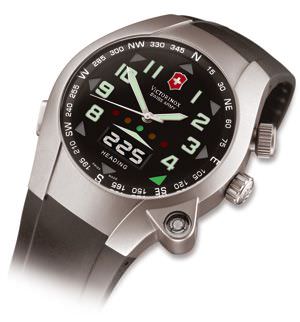
As a former pilot, there are two watches that represent the absolute finest gear for flying: the Omega X-33, and Breitling Aerospace. Both are quartz and analog/digital, and have very different looks. Today's post is about a very similar watch that has a much more reasonable price tag to the Aerospace, the Victorinox Swiss Army Classic XLS MT. I've not yet confirmed this, but I strongly suspect that it has the exact same movement as the Aerospace, the ETA 988.432, making it one heck of a deal. Specifications of the Victorinox are:

* Swiss made, Swiss quartz movement.
* Anti-reflective-coated sapphire crystal.
* Stainless steel case, PVD-coated 'gunmetal'.
* Luminous hands and hour markers.
* Crown guard.
* Countdown timer, alarm clock, stopwatch, dual time zone, multiple languages.
* Water resistant to 100m.
* 45mm by 12m, quite large.

List price is shown as $1,095USD, but I would expect a discount from that. Let's compare to the Breitling Aerospace:

* Titanium case.
* Night-vision-goggle-compatible backlight. (I have no idea what that means, but it sure sounds cool.)
* Second timezone, alarm, stopwatch, countdown timer.
* Crown-driven operation.
* 100m waterproof.
* AR-coated sapphire crystal.
* 42mm by 10.4mm, 38g.

Picture_1(Picture snipped from the Breitling website)

You can kind of see from the pictures that the displays are identical, which makes sense if the movements are the same. You can also see that the Victorinox is larger. 45mm is large but not huge; I'd be happy to wear one.

As with many Swiss brands, Breitling bars selling over the Internet, but Amazon sells them with a list price of $2,795.

There are two things I dislike about this movement: the lack of a second hand (useful for 30-second turns), and the crown-driven operation. It's really hard to manipulate while wearing it, which limits the functionality a bit. Nevertheless, I'm hoping that I can try the Victorinox, as that price is much more up my alley, and I really like how it looks.

http://www.watchreport.com/

posted under , | 9 Comments

Omega Adds a New Bond Seamaster

Omega and James Bond have had a long and mutually profitable relationship. It used to be a Rolex Submariner that Q modified with non-standard complications and handed over to Sean Connery to get him out of tight situations, however starting with Pierce Brosnan in Golden Eye the Omega Seamaster became the choice of British spies. Omega seized the opportunity to not only make James Bond a brand ambassador, but they also created the special James Bond Omega Seamaster.

Now that there's a new Bond, Omega has taken the opportunity to outfit him with a new tool: the Omega Seamaster Planet Ocean. I've written about the Planet Ocean and handled several under the watchful eyes of jewelry store clerks, and they are truly majestic watches -- very fitting of Bond, and an excellent choice for a fresh beginning of the Bond franchise.

What I find interesting, however, is that to my knowledge, Rolex never made a limited edition commemorative James Bond Submariner while Omega has released a couple Bond Seamasters. I'm guessing the idea of soldering a "007" to the end of a Submariner second hand, or adulterating the dial with some Hollywood inspired action graphic made the folks at Rolex swoon. Frankly, I'd have to be a pretty big James Bond fan to drop that kind of money on a movie souvenir, but I suppose if you're a collector, there's nothing like the phrase "limited edition" to get you on the phone with your favorite authorized dealer.
Article Source : http://www.watchreport.com

posted under , | 0 Comments

History of Casio Watches

Sometimes things start out in the most surprising ways. Take the watch company of Casio for example. If you were asked to guess what the first product that was made by Casio, you may think it was the calculator or some other type of electronic product. You would be wrong. The Casio Company was started 1946 by Tadao Kashio. Understand that this was in Japan following World War II. The financial situation was dire in Japan at the time to say the least. When Mr. Kashio began his company, he was a fabrication engineer hoping to catch a big break.

His big break showed up in a very unique way. Tadao Kashio developed a product called the yubiwa pipe. Its design allowed it to be worn on the finger. It was used to hold a cigarette, allowing the smoker to smoke the cigarette to the filter, all while still being able to use both hands. In the impoverished Japan of the times, cigarettes were a hot commodity and the product was an overwhelming success. The yubiwa pipe is a far cry from the calculators and watches that were to follow, but it did start the company down the road to success.

Since it is obvious that Mr. Kashio was an inventive sort of man, it only took a little while for him to decide to explore different products. At the business show in Ginza, Japan in 1949, he discovered electronic calculators. With the proceeds from the sale of the yubiwa pipes, Mr. Kashio and his brothers began to experiment with making their own calculators. At the time, most calculators were run by the use of gears. With diligence and hard work, the Casio Company came out with the first calculator to use solenoids. The new type of calculator went on sale in 1954. This calculator also was the first to have the 10 digit keypad and had only one display window as opposed to the competitors' that had three.

As you well know, calculators weren't the only product manufactured by Casio. After the release of the Model 14-A calculator, many more products were designed and released to the general public. The same year as the release of the 14-A, the company also became the Casio Computer Co., Inc. This is about the time when watches from Casio first made their mark on the watch industry. Casio has been well known for the huge variety and innovation of their watches almost since the beginning of production. They were one of the first watch companies to manufacture the now famous quartz crystal watches. The quartz watches produced by Casio were available in both digital and analog styles. It is possible that the most well remembered watch produced by this company was the calculator watch. For those of you who don't remember, it featured all of the amazing time keeping capabilities of the regular Casio watches, with an added feature. It had a tiny calculator complete with miniature keypad built into the watch. During its hey day it was the bane of math teachers everywhere and the savior of every math deficient student.

Considering the calculator watch was so much fun, Casio continued to raise the bar. This company was also the first to design and produce a watch that could provide its owner with some interesting details. One such watch could display the time of many different time zones at the touch of a button. Others were equipped to give weather details like the temperature and barometric pressure. Mountain climbers of ages past particularly were fond of the version that came with a gauge to indicate the altitude. While other watch makers were stuck on the same old, same old, Casio consistently offered new and exciting variations on the classic wristwatch.

With the true gadget geeks of the world in mind, Casio came up with a watch just for them. It is the Wave Ceptors line of watches. They really outdid themselves with this one. These watches are equipped to receive radio signals that enable the watch to keep accurate time. They also are able to tell the time in different time zones, the user can set alarms and timers. This line of watches also came with an incredibly extensive user manual to provide all of the necessary instructions to the owner.

From the yubiwa pipe to the finest calculators and watches in the world, the Casio has come a long way from its humble beginnings. They continue to challenge themselves and their competitors to new higher peaks and offer the best products electronics can build.

posted under | 0 Comments

Can Luxury Watch Market Continue to Grow During the Economy Crisis?

Luxury watches in the United States are quite popular. Although not everybody wears one of these, if you do, it is safe to say that you are showing off your style in a good way. Many of the most popular luxury watch models sold in the United States are manufactured in other parts of the world. But with that being said, it does not matter where the watches come from. The only thing that does matter is that the luxury watch market in the US is on the up and up……before the US economy crisis hit.

Prior to economy crisis, why are luxury watches so popular in the US? First and foremost, people want to look good. If you are going to buy a watch, you might as well search for one that is known for its luxurious look and feel. For instance, if you can afford a Rolex you will be wearing one of the most popular luxury watches in the world. For this reason, you will not only feel good, but you will look good at the same time. People don’t mind spending their future money to make them look good.

Another reason for the increased popularity of luxury watches is status. In today’s day and age, more people than ever before are interested in showing the rest of the world just how much money they have. If you are interested in showing that you live the high life, there are many ways of doing so. Wearing a luxury watch that carries a price tag of several thousand dollars is one of the best ways of doing this……wearing these watches had become a must for the Wall Street’s people.

One of the biggest benefits of the luxury watch market in the United States is its depth. In other words, there are many different options available, as well as several price points at which you can purchase them. For instance, you will find that some Rolex watches can be had for as little as $5,000 whereas others are pushing $15,000. A market that offers products at a wide range of prices makes it easier for more people to get involved.

There are quite a few luxury watch brands that have become popular in the United States. In addition to the biggest name, Rolex, there are many other including Longines, Tag Heuer, Omega, Panerai, Versace, Fendi, LV, Chanel and Breitling among many others.

Had the economy not melted down, it is safe to say that the luxury watch market in the United States is going to continue to grow over the next few years. Economy crisis changed the landscape and outlook of luxury watch market entirely. It may not be a good idea anymore to wear luxury watches when people are jobless. Even if people have to wear it, they are looking at cheaper but good quality which can continue to make them look good and yet save a lot of their money. That’s why a lot of people in the US are also looking for alternative watch to wear, and this includes replica watches.

Replica watch can be a hit again during this global economy crisis and it may become a good way to help people save money. www.perfect-watch.com is one of the leading sites that help people save money and yet makes them look good during this difficult period.
Article Source: http://www.articlesbase.com/

posted under , , | 1 Comments

History of Gucci Watches

Guccio Gucci, son of an Italian trader founded the House of Gucci in Florence in 1906. Guccio, an extraordinary craftsman, started selling luxury goods in the 1920s. In 1938, Gucci opened a boutique in Rome. After Guccio's death in 1953, his son, Aldo expanded the company by opening more stores. In 1953, New York got its first Gucci store and by the late '60s, more such stores were launched in London, Paris and Tokyo. Gucci continued to be one of the leading luxury brands until the late ‘70s. After that a string of devastating business decisions led the company to the brink of bankruptcy.

To gain its lost glory, the brand made its entrance into the watch market once again in the 1990's. This step was taken to put emphasis on their place in the fashion market. Gucci watches commenced its production in 1997 by means of an attitude based entirely on advanced quality, precision and thought to detail. Gucci pooled its creative skills in the midst of an unparalleled accuracy of Swiss craftsmanship to produce Gucci watches.

In the same year 1997, Gucci Group got hold of the operating assets of the ‘Severin Montres Group’ (being the world's leading manufacturers and distributors of watches) and fashioned its first Timepieces. To gain an upper edge in the market, the group went on to take some bold steps in the form of mergers and acquisitions in 1999. It bought ‘Yves Saint Laurent Couture’ and ‘Sanofi Beauté’ and also claimed a 70% stake of Sergio Rossi.

This move provided Gucci with a strong base in the form of market coverage and it got a "prepared" market to launch its watches. The plan to take control of the whole market got a boost in the year 2000 when it acquired Boucheron International group. It created a ripple effect in the market by securing license rights to run ‘Yves Saint Laurent Couture’ watches.

All these moves not only placed it in a stronger position but also replicated Gucci's promise to be a leader in the worldwide watch market. By initiating such steps, Gucci made a place for itself in the luxury goods market as well. Gucci watches quickly earn recognition as each watch are mark of a distinctive style by means of a fresh edge and urbane flare.

Gucci watches are largely procured by fashionable men and women who appreciate its design immensely even without taking care of its movement and an array of utilities. Right from the beginning, it has presented only the fashionable watches to win over the hearts of youths.

Stainless steel, sapphire crystal and soft silver are some of the major constituents, characterizing the appeal of the brand. Soft silver is still extensively put into use to fashion some of the model’s dial. Its model 3900, launched to nullify another rival’s product, possesses a fabric wristlet. Now when a niche has been created for its products, its watches presents sophisticatedly designed timepieces, standing at the very summit of excellence. They are churning out watches, both exciting and seductive, of the finest Swiss watch design, in their own style and grace to give a tough fight to rivals.

The watch’s core design follows the Swiss movement which is known for its dependability. Whenever the designer watches are no longer in fashion, you might come over this dilemma by going to the Gucci way, which assures of consistency.
Article Source: http://www.articlesbase.com/

posted under | 4 Comments

Hot New Diamond Jewelry And Swiss Watch Trends

The jewelry industry has gotten very creative over the last couple of years and with that creativeness has come an amazing assortment of jewelry designs. Technology has also advanced and complicated styles that weren't possible are not being made. Finally, manufacturing costs have come down and now can you choose from an amazing collection of jewelry styles while spending much less than in years past. Read more and you'll learn what's at the front of the pack.

Add-A-Bead Charm Bracelets

Pandora and TrollBeads have created a new phenomenon in jewelry that includes a contemporary spin on the charm bracelet. TrollBeads is a brand name "add-a-bead" charm bracelet designed by Scandinavian artists using sterling silver and Murano glass beads. The silver beads are a collection of symbols and animals each with a meaningful story behind them. Each artist has there own bead that they've created using inspiration from mythological stories and fairy tales. The Murano beads are hand-blown genuine Murano glass - made by Italian craftsman. Pandora is similar in style and concept but places a bigger emphasis on the silver while TrollBeads has both sterling silver and glass to choose from.

These charm bracelets make wonderful gifts and most people buy one for themselves as well as for friends. The beauty of the jewelry is the ability to build bracelets together with friends and family, once built they look amazing and very fashionable.

Yellow Gold is on the Move

For years white gold and platinum have dominated jewelry fashion however, many jewelry designers are now showing new styles in yellow gold. This recent movement has been seen in styles created by Tacori and Simon G, most notably with Tacori's new yellow gold Medallion. This medallion has been voted the hottest new jewelry style by readers of various women's magazines. What we've seen is that women are now wearing yellow and white gold jewelry together and it seems to be quite fashionable. Look for two-tone bridal jewelry to make a comeback very soon as well.

Be a Star

Tiffany & Co. has been selling a diamond studded silhouette of a star and this necklace has created an interest in star jewelry. You'll notice many jewelry stores carrying similar stars in necklace, pendant, rings, and earrings. Most of these stars are basic but classy looking 5 point stars pave set or channel set with round diamonds or baguettes. Carat weights for these items normally range from .25ct to 1.50ct total diamond weight. These styles have been hitting the market since Summer of 2007 but you'll see many more variations as time goes on.

Journey Jewelry Debeers created the concept of Journey Jewelry a couple of years ago but it took a while to catch on. Recently, it became one of the most popular diamond jewelry gifts available. Journey Jewelry is created with a collection of diamonds growing in size from smallest to largest, these diamonds symbolize the growth of love that people have for one another. As your love grows so should your diamonds, at least that's what Debeers believes. Journey styles have been shown mostly in white gold set with princess or round diamonds. The concept is based loosely on the Past, Present, & Future 3-stone jewelry that was also created by Debeers. You can view great diamond journey jewelry styles at http://Rokstok.com.

Automatic Swiss Watches

For men, fine quality Swiss watches have become a very important choice in timepieces. The sport watches created by Movado, Rolex, and Breitling have driven the market and still remain the leaders in men's wrist watches. Another craze seems to be oversized or very large watches, you'll see this in many of the Breitling designs. The styles are getting bigger and bigger and the bold use of decorative dials is quite striking.
Article Source: EzineArticles.com

posted under | 0 Comments
Older Posts Home

Followers


Recent Comments