Showing posts with label Review. Show all posts

Momentum Pathfinder II - The "PATH" travel.


This is the Pathfinder II, an outdoor-focussed creation from Momentum watches of Vancouver BC. Aimed at the active outdoors life, it’s my favorite combination of titanium and sapphire. Let’s start with the specifications:

  • Titanium case, waterproof to 100m (330ft). Screwdown crown, non-screwdown alarm button at 2 o’clock.
  • Sapphire crystal (mineral version also available)
  • Quartz movement with date and analog-set alarm with snooze function.
  • 37.4mm by 10.2mm thick, 40.4 including the crown. 45g including strap. 20mm lugs.
  • Model number reviewed is 1M-SP54L12C; also comes in black-dial and women’s version in 28mm.
  • List price of $185 for mineral crystal, $225 for sapphire.
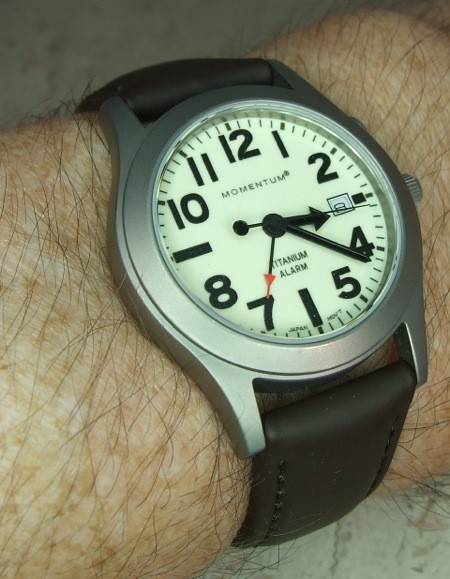
I thought I’d start with the lume picture. In person it’s spectacular, almost painfully bright at glowing at the least hint of illumination. Black on green takes some getting used to, but its crazy bright and easy to read all night long. Easy to discern time from the alarm hand, too.

The Pathfinder II is an interesting set of design decisions. At 37mm it’s mid-sized for a 2012 mens watch, and at a featherweight 45g you’ll often forget you have it on. The leather strap is backed with a textured rubber that keeps it from slipping around; even while playing outdoor volleyball it stays in place. One of the few watches light enough for that sport. The buckle is actually stainless steel, finished to match the case.

On the wrist, mine is the average 7.25″. Quite understated and thin enough to slide under snug cuffs easily. The bead-blasted titanium is non reflective and a lovely, even grey color that I quite like. Stronger and lighter than steel, titanium is easier to scratch and will thus quickly acquire wear. It also feels ‘warmer’ than steel due to its lesser heat capacity. I would recommend spending the extra for the sapphire crystal, as they are much harder to scratch and will keep the watch looking flawless for years.

Leather bands wear out, of course, I usually get around a year on mine but since the lugs are standard replacements are inexpensive and easy to find. There’s a titanium bracelet available from Momentum too if you’d prefer that.

As you can see here, the fixed bezel is bevelled; very shirt friendly. The black dial version is probably a bit more versatile in terms of dressing up, but this version is good to go up to business dress in my opinion.

The alarm is a great feature to have on a watch, a simple once-every-12-hours analog set, as simple as can be. The beep will wake most sleepers, more so if you take the watch off your wrist which lets sound emerge from the back. Pull the alarm button at 2 o’clock out to enable it, push in to disable. If you don’t turn in off when it sounds, it’ll keep sounding at 3 minute intervals. Like the rest of the watch, a useful feature simply implemented.

This Pathfinder is kind of the opposite approach to outdoor watches from Casio’s Pathfinder series. Those exemplify adding everything into a watch; maximum features and size. The Momentum is simple, with clean lines and minimal stuff. No manual reading needed. Which you choose depends strongly on your own preferences.

The case back is also very straightforward. I like that it’s rated to 100m, and would recommend you get a different strap if you’ll be using immersed. Leather, however well sealed, does not like being soaked too often. Also note that the depth rating depends on the alarm being off (button not extended), so check before going over that waterfall in your kayak!

Momentum includes a 2 year warranty, with extensions to four and six years available with full service. If you’re consider this versus, say, a Timex Expedition, I would say that the Momentum should last you a lot longer and wear much better.

I like this one. Easy to read, durable, super light, a good watch for those folks who want something good to wear everywhere.

posted under | 0 Comments

Helson Buccaneer 47mm (The Underwater Glow)

Did you impressed by the Helson Shark Diver 42mm wrist watch that we already take review last month ? amazing isn't it ?, then we were curious to see what Helson would release next. Regardless of our estimations, the new Buccaneer 47mm would have been hard to predict. The original Helson Buccaneer was a 45mm GMT diver with an external bezel and a stainless steel case and was one of the early stars of the Helson brand. This new Buccaneer 47mm has almost nothing in common with the original, instead featuring titanium construction, an internal bezel and a massive 47mm case. This new Buccaneer is a distinct and rather original design from Helson, and we were quite excited to see it in person and try it for ourselves. Boasting an unusual case design but displaying all of the traits of a capable sport diver, the Buccaneer 47mm is definitely worth considering if your taste in divers strays towards the extra large persuasion.


The specification we already receive, said that : 

  • They have 47 x 18.2 mm (at top of crystal) width
  • 14.5 mm tall at case edge height
  • 52 mm Lug to lug
  • Titanium case and bracelet for anti rust system
  • 170g Weight (as reviewed)
  • ETA 2824-2 Automatic movement
  • Domed sapphire crystal with internal anti-reflective treatment
  • Helium Escape Valve (HEV)
  • 24 mm drilled lugs
  • Internal reflector bezel (two o’clock crown control)
  • 1000m WR
  • $1099 in a brushed or blasted finish (want to buy some ? :D)

The Buccaneer comes delivered in the same screw-top “diver’s tube” that many of the indie brands are using and, encased within its fitted foam interior, you will find the Buccaneer 47mm, a titanium bracelet, rubber strap and a strap changing tool. The Buccaneer has a a 47mm titanium case which is quite wide and, along with the massively domed crystal, is a whopping 18.2 mm tall. The Buccaneer’s 52 mm lug to lug length keeps it from being altogether too large for my 7.5 inch wrist. For a size comparison, consider that the 42mm Ocean7 LM-5 GMT is 53mm lug to lug, which is longer than this Buccaneer, regardless of its 47mm case size. So, while the Buccaneer 47mm is quite large, its shape is conducive to being worn on average-sized wrists.


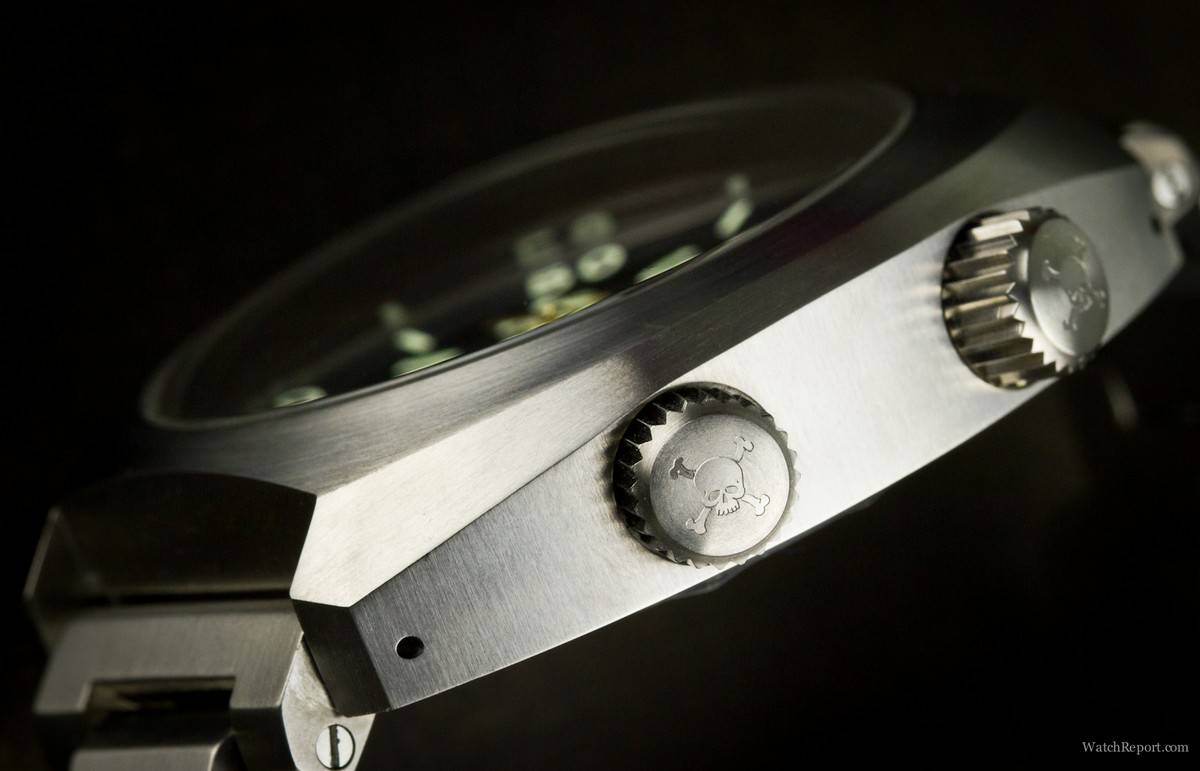
Image 1. Side View of Helson Buccaner 47mm

Besides the unique and rather modern case shape, the domed crystal stands out as one of the most noticeable elements of the Buccaneer 47mm. The crystal is beautifully integrated into the curvature of the case and the crystal itself has been treated with an anti-reflective coating on its internal side. Even with the anti-reflective coating, reflections are often prominently displayed on the crystal thanks to its highly curved shape. In day-to-day wear I did not find the reflections to compromise the view of the Buccaneer’s dial which is physically quite large and also employs over sized markers and numerals for increased legibility.

The Buccaneer 47mm’s two-crown design aligns the lower crown (which does screw down) with the date and timekeeping control while the upper crown (which does not screw down), has bi-directional control over the internal reflector bezel. Both crowns feature a skull and crossbones motif which is also seen on the Buccaneer’s clasp. The Buccaneer 47mm can be had in either a blasted or brushed finish (as seen in this review). The finishing on Buccaneer 47mm is excellent, employing even brushing and crisp case transitions.

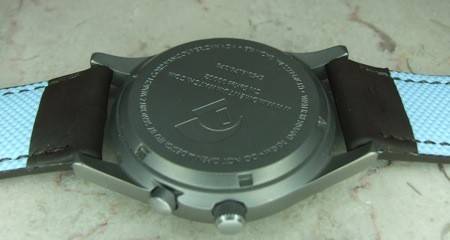
Image 2. Exact view from behind

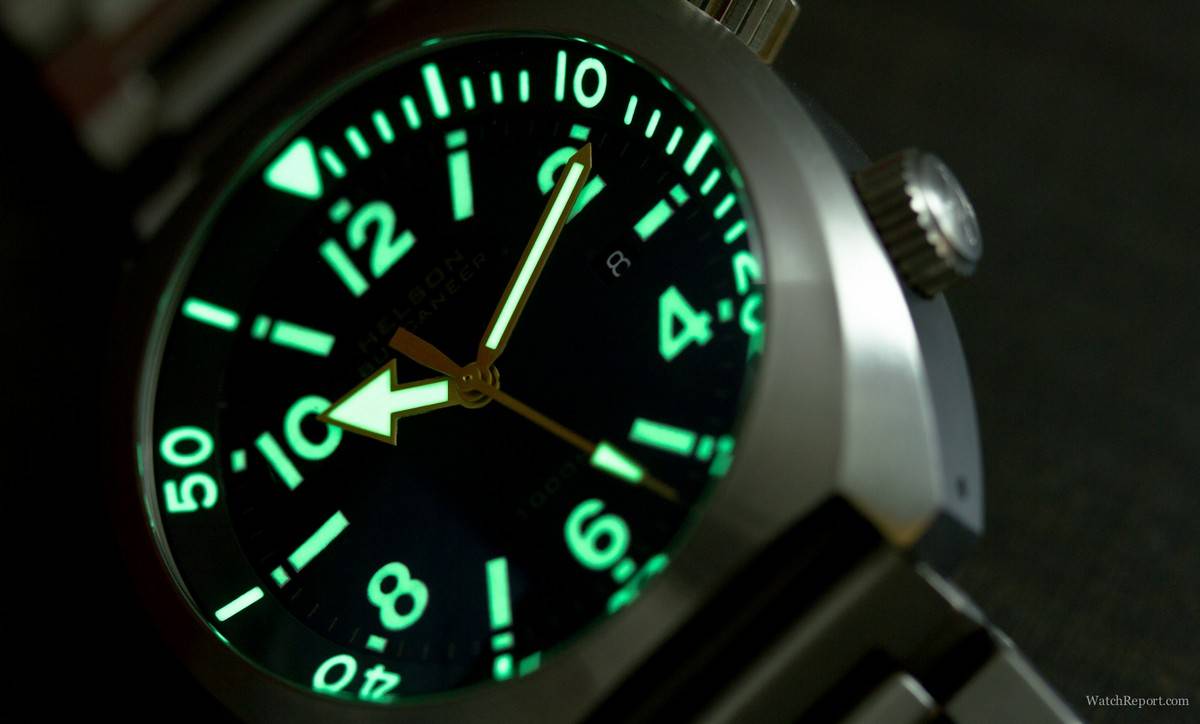
The only carry over from the original Buccaneer is the 47mm model’s dial which features prominent military styling with over sized markers and numerals as well as a large and highly legible gilt handset which leaps off the dial. The date is seen through a small and unobtrusive window at three o’clock. The hands, markers, and entire bezel scale is fully lumed and glows brightly and with good longevity (see video). The lume application between the main dial elements and the bezel elements appears to be comparable so the visual power of the lume fades evenly and the bezel, with its light but positive action, is a welcome and practical feature which can easily be employed in low-light situations.

The Buccaneer 47mm is water resistant to 1000m and features an automatic helium escape valve at nine o’clock and the titanium bracelet features an integrated fold-out diver’s extension. While many dive watches may boast increasingly ludicrous water resistance claims, the Buccaneer, with its legible dial design, ample lume and domed crystal, seems like it would make for a great dive watch. As I am not a diver, I cannot attest to the practicality of an internal bezel for dive timing (even if only as a backup) but the crowns are fairly small and may be somewhat difficult to use while wearing gloves.

Image 3. Brilliant and clear bio luminescent


Thanks to its titanium construction, the Helson Buccaneer 47mm weighs in at a completely manageable 170g once sized for my wrist. Given its over-sized wrist presence I expected a weight in the low 200’s but was pleasantly surprised at how light the Buccaneer 47mm wears on wrist. The case back rests evenly on the flat of my wrist and the case edges did not cause any discomfort (a problem I’ve encountered on other 45mm+ watches). The Buccaneer 47mm was comfortable and exceptionally light on-wrist, especially when fitted with the included rubber strap.

Timekeeping is provided by the ETA 2824-2 Swiss automatic movement and was seen to be as reliable and accurate as any would expect from the robust but non-COSC version of this Swiss caliber. The ETA 2824-2 is one of the most widely employed of ETA’s movements and can be found in literally thousands of watch models as it has proven to be a reliable, cost-effective (both in manufacturing and eventual servicing) and highly capable three-hand Swiss automatic movement.

The bracelet features the same link design as the bracelet included with the Helson Shark Diver 42mm, but the Buccaneer 47mm’s bracelet is all-titanium. Featuring screwed link construction, a signed fold-over diver’s clasp with four micro adjustment positions and a fold-out wetsuit extension, the bracelet is nicely made and does not rattle nor pull hairs. Unfortunately, Helson did not include fitted end-links to better integrate the bracelet into the Buccaneer 47mm’s case, opting instead for straight links which makes the bracelet seem like an aftermarket option.

When on wrist, the height of the Buccaneer becomes very noticeable as it will not fit under most cuffs thanks to its 18.2mm thickness. The case is actually only 14.5mm thick but the domed crystal makes up the difference and, along with the 47mm case size, make this new Buccaneer a very casual and sporty watch. Best combined with a t-shirt, or perhaps a wetsuit, the Buccaneer 47mm is a very masculine and tough looking watch, especially when worn on the included bracelet.

Helson has priced the Buccaneer 47mm at $1099 and while I believe that price to be competitive, based on the Buccaneer 47mm’s spec sheet, there isn’t really any direct competition that looks anything like the Buccaneer 47mm. Aesthetics aside, this Helson will likely have to contend with the Benarus Megalodon but aside from price, case size and movement, the two are very different watches and may prove to appeal to different buyers. Much like the Megalodon, I find the Buccaneer to be a bit to big and thick for my tastes but it is very nicely made and if you prefer a large but light dive watch, the Buccaneer 47mm is definitely worth careful consideration.

posted under , | 1 Comments

Phosphor Appear !!

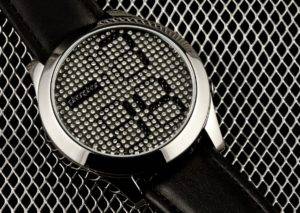
It is a rare day that a watch comes in that we can easily describe as being “unique” in the manner in which it displays the time. At time gallery, we generally see a lot of 3 handed dive watches, quartz chronographs and multifunctions digitals, none of them being especially unique when it comes to physically pointing out the time. Thanks to Phosphor, who you all likely know well for their work with E-Ink based watches, we can safely claim we have something rather original to show you today. The Phosphor Appear is a quartz watch with a bejewelled and somewhat mechanical way of showing you the current time. Phosphor has really created something different in the Appear so lets take a closer look:

  • 44 x 15.5mm
  • 49.5mm (lug to lug)
  • 22mm Lugs
  • Dial adorned with Swarovski crystals
  • M3D 7 Segment physical display
  • 50m Water Resistant
  • Black leather strap
  • Price Assume : $199
At first glance, especially in the “off mode” the Phosphor Appear looks like a silly fashion watch with too many gems on the dial (the dial is literally paved in Swarovski crystals). When the top pusher at two o’clock is pressed the Appear transitions to “time mode” and the display jumps to life. A magnetically actuated seven segment physical display swaps bejeweled areas for black segments that display the time in a readout that is familiar to anyone who has ever owned a digital alarm clock. As the time advances, the matrix of jewelled areas are progressively modified to show the time. This is all done using Phosphor’s M3D (Micro-Magnetic Mechanical Digital) technology that uses an electromagnetic field to change the positions of each cell, allowing them to create any number (0-9) in the contrast of the jewelled dial. This is almost impossible to describe in text so please, even if you are not interested after seeing the included photos, check out the attached video. The overall effect is definitely a party piece and it left even the most staunch objector with a sly smile on their face. In addition to the visual element of watching the display transition from time, to just seconds, to off and back on again there is an absolutely charming mechanical click as each segment falls in or out of its place. This is something you have to hear in the video, its my favourite part of this watch as it makes a sound something like a typewriter writing in Morse code.

The rest of the case is a polished stainless steel that is of a fair grade for its price and is shiny enough to match the dial. There are options in both the men’s and the woman’s variants of the Appear for a jeweled bezel. The woman’s line can also be had with red or pink jewels in the time telling array for a flashy effect with additional contrast. The Appear comes mounted to a simple and soft black leather strap, very comfortable with subtle matched stitching that compliments the watch nicely. At 44mm wide and 15.5mm tall the Appear is in a larger category usually home to divers and chronographs, not fashion watches. That said it doesn’t wear overly large but will definitely get noticed given the blinked out dial.

Generally, when you hear “unique” in any review of a watch you should be reaching for your big-boy (or girl) wallet. In watchmaking, anything that is bespoke or custom produced will come with a fair but lofty price tag. Luckily, the Appear wont break the bank with its $199 price point. No, its not high end watch making nor is it really my style given the sparkle that comes from the dial but it is a fun watch that isn’t taking its self too seriously and I have become addicted to the sound of the movement.

Our thanks to Phosphor for providing a review sample.

posted under , | 0 Comments

Casio Pathfinder PAG-240

Casio recently updated their mid-range Pathfinder lineup — the "Solar Triple Sensor" line — by adding the PAG-240 which sports a series of refinements. The Pathfinder line is famous for melding large LCD screens with navigational and atmospheric data, all in a wrist-top package. The Casio PAG-240 uses a new duplex screen, and a new manner of navigating its many features.

  • Plastic resin case
  • 51 x 15.5mm, 65g
  • Casio 3246 movement (+/- 15 seconds)
  • Solar powered
  • Compass
  • Altimeter
  • Barometer
  • Thermometer
  • Sunrise/sunset timer
  • Duplex LCD (two layers)
  • Countdown timer
  • World time
  • Automatic Calendar
  • Auto back-light with afterglow feature
  • Resin strap
  • Retail price of $250
This mid range Pathfinder sports most of what the higher end models have but, omits the radio synchronization for timekeeping. This allows the 240 to come in at a lower price but still offers much of the feature set available in the higher end models.

Casio has refined the PAG-240 with a new duplex screen which incorporates the main screen and an additional layer of "lines" on top. These lines can display an additional time zone, compass information, sunrise and sunset, or help you cycle through the menus. The new menu navigation is possibly the best feature of the PAG-240; as you cycle through the modes the duplex screen indicates what mode you are currently in — a huge improvement over the previous navigation systems. Combine that with the small matrix screen at 11 o'clock, and you can get a lot of information all at once without having to keep pressing buttons (see the video review for a demonstration).

In the past, I have not been able to wear an ABC (altimeter, barometer, compass) watch full-time because I always found they were too complicated to be instantly usable, but this is not the case with the PAG-240. The PAG-240 combines useful features and an intuitive user interface into an unbelievably light package. This Pathfinder actually weighs nearly half as much as the last dive watch I bought, and feels comparatively like you're not wearing a watch at all.

Retail price for the PAG-240 is $250 which is a good price for the complete package the Casio has going with this watch.

posted under , | 0 Comments

Casio Pathfinder PRW-5000-1ER

If there's any one company that continues to innovate, it has to be Casio. Their newest Pathfinder/Protrek, the PRW-5000, takes their kitchen-sink feature list and completely rethinks to design with an emphasis on analog hands.

Let's start with the features:

  • Solar powered.
  • Atomic timekeeping, six bands: US, UK, Germany, China, Japan (2x).
  • Altimeter, barometer, compass, and thermometer.
  • World time, stopwatch, countdown timer, five alarms.
  • Low temperature resistant down to -10C.
  • Water resistant to 100m (330ft).
  • Mineral crystal, fixed stainless steel bezel.
  • Casio movement 5114 (PDF), with self-correcting hands.
  • 49mm across, 14.6mm thick, 85g on the 22mm resin strap.
  • List price of $450.
Casio completely changed the look this time, yielding a watch whose complexity is less obvious. As a fan of analog-digital watches, this instantly became my favorite Pathfinder. There are, of course, compromises with the design, so read on to see if you agree or not.

In this design, the second hand is used to replace the second LCD layer in previous designs. It acts as compass needle, barometric pressure indicator, and altimeter, with the latter two read out from the orange inset on the dial. There's a graph on the right hand side of the LCD that shows trends over time for pressure and altitude to complement the instantaneous readout. Since the LCD is smaller in size, modes and indicators are more terse ('TR' instead of 'Stopwatch', for example), so reading the manual is required to learn how to use everything.

The watch is pointing close to due north, with the LCD showing the precise reading and the second hand approximating. Note that the second hand jumps, updating once per second and indicating to the closest minute marker. This works well, but takes a bit of getting used to as it differs from a magnetic compass. Note also that the compass is disabled when the LED is on, so you can't navigate at night with it (unless you have a flashlight, which you probably will).

The altimeter and barometer mode function similarly in that the second hand indicates relative readings on the orange section of the dial from 11 to 3. You can set two scales for the altimeter, and the barometer mode is quite nice for sailors or fisherman, as changes are visible quickly. I had no problem reading time and altitude change while biking on rough ground.

In time mode, you can switch the display from day of the week to barometer graph mode on the LCD by pressing Adjust -- a nice feature that I appreciate. Each pixel shows 2 hours, giving a days' view at a glance.

Nighttime viewing is done via a blue-white LED at six o'clock. The dial is brilliantly lit, and the LCD is fairly well lit, as well. I worry about impairing night-adjusted eyes, as the light is quite bright, but otherwise it works great. I like that solar power removes any worries about running down the battery with the backlight, too. In fact, every hiking watch should be solar powered in my opinion. It's just one less thing to worry about before you set out.

StrapCase, caseback, and strap are classic Casio: simple, functional, comfortable. There's an inset metal segment that I could do without, but it does complement the design. On this model, Casio went with a stainless steel bezel with four probably-decorative screws and nice crosshatch pattern. It looks great -- more durable and nicer looking than plastic. It's even satin-finished so reflections aren't a problem.

The main appeal of the Pathfinder line is you can grab it and go on anything from a dayhike to the Appalachian trail and never worry about your watch. Durable, water resistant enough at 100m, quartz-accurate even when it can't get a radio signal, and a good backup for your primary navigation, too. They're not cheap at $450, but good outdoor gear is no place to pinch pennies.

posted under , , | 0 Comments

Seiko SBDC005, The "Sogun" from Seiko Corp.

The Seiko SBDC line, dubbed the "Sumo" or "Shogun" by online collectors communities, have been out for a couple of years. Nevertheless, they are worth a detailed review. Today we will be takeing a closer look at the SBDC005, which is the orange version of the Sumo. This particular example was purchased with the bracelet that is normally only available on the black or blue dialed models. The Sumo represents Seikos response to the modern dive watch, the SKX series and their 7S26 movements have been staples of the dive watch world for years, but movements and manufacturing processes have improved. Seiko responded by making a Prospex dive watch with the venerable 6R15 movement from the Alpinist line. How does it stack up against the competition or even its cheaper SKX siblings?

  • Automatic 6R15
  • 50hr Power Reserve
  • 44x13.3mm
  • 20mm lugs
  • Hardlex Crystal
  • Screwdown Crown
  • 200m WR
The head on the Sumo is very nice, it is a definite step forward compared to my trusty SKX007. The Sumo has some very nice finishing on the sides of the case, mixing vectored lines, brushed and polished surfaces and even lug holes. The bezel action is smooth and clicky but the notched edge of the bezel is useless. Water or sweat will make using this bezel difficult without gloves. So much about the Sumo seemed to be designed with the intention of owners using it for diving that the bezel is a definite disappointment. While I think calling the SBDC a "tool" watch might be a stretch, it has the calling cards of a tool diver. Big hands and markers, an excellent screw down crown, and lug holes. I know many Seiko fans didn't like seeing lug holes on such a dressy looking diver, but it makes strap changes a blast and I love lug holes on any watch. Many divers have used the SKX (007 or 779) as dive watches and I believe the Sumo would easily be up to this task.

The orange dial on the SBDC005 really pops, it is bright and rich and really makes this watch feel like a dive watch. I generally prefer black dials on my dive watches but have very much enjoyed the orange dial, especially on a black rubber strap. The hands are sword style, like those seen on the SBDA005, and have a black border. This last point brings us to my biggest problem with the watch - the hour markers are outlined in a shiny chrome but the hands are outlined in black. This is a small inconsistency that I am reminded of every time I look at the watch. While we don't know why they made it like this, I think the markers would have looked awesome outlined in black. My guess is the chrome accents are to remind buyers of the upmarket Seiko SBDX001 Marine Master. All other marks, writing and even the border of the date window (at three o'clock) are black. On the SBDC001 and 003 (black dial, blue dial respectively) the hands are outlined in chrome, so this issue is only present on the orange dialed model. The lume on the Sumo is excellent and lives up to the repoutation set by its siblings.

The bracelet is very nice, the 20mm width that the lugs is odd at first as 22mm would be more standard for both Seiko and the size of the watch. That said, the bracelet is of standard Seiko quality: it's quiet, doesn't pull hair, and has solid end-links. The clasp is a push button fold over style with four micro adjustments and a safety. These links are secured by standard push-pins and there is a simple wetsuit extension hidden under the clasp.

In the end, the SBDC005 is a classic Seiko dive watch and there is very little to complain about. The movement is an upgrade from the more commonly seen 7s26, and the build quality is great. The Sumo will cost you quite a bit more than a SKX series watch - on bracelet the SBDC001 retails around $600. For your money you get a classy but dive-capable watch that will keep up with most styles, and may just make a perfect daily wearer.

posted under , | 0 Comments

The Omega Speedmaster Professional

I have a thing for durable watches. Finding a watch that can stand up to an active lifestyle, and still look good and keep great time over the period of many years, is surprisingly difficult. If you want a really robust watch, the conventional wisdom is to go with a Casio G-Shock if you're looking for a quartz or digital solution, and a Rolex if you want something Swiss and high-end. But Omega fans know there's another option which has one of the most interesting backstories in the history of horology.

The Omega Speedmaster Professional lands squarely between a high-end G-Shock and sport model Rolex in terms of price, looks fantastic, and has stood up to some of the most rigorous testing that any watch has ever been subjected to. Not only have Speedmaster Pros gone into space on many occasions, but they have actually been worn outside a space suit on the surface of the moon.

Before I get into the history of the Omega Speedmaster Professional, let's cover the specs:

  • Stainless steel case and bracelet.
  • Legendary Speedmaster bracelet with push-button release.
  • Caliber 1861 manual wind movement; rhodium plated for corrosion resistance; 48-hour power reserve.
  • Hesalite crystal (a type of plastic similar to Plexiglass -- very shock resistant).
  • Water resistant to 50 meters, or 167 feet.
  • Chronograph function (with "small seconds" at the 9 o'clock position), and tachymeter.
  • 42mm case diameter.

As you can see, the Omega Speedmaster Professional isn't a fancy watch in terms of complications and features. It has to be wound manually, it doesn't have a date display, I wouldn't get it wet beyond a shower, and the crystal is relatively easily scratched. But what it does have is a combination of simplicity, build quality, and well chosen materials that make it one of the most robust and interesting watches currently on the market. Let's take a closer look.

The Bracelet

This was my first experience with the legendary "Speedy" bracelet, and I'm hooked. I've handled a lot of stainless steel bracelets over the years, but I'm pretty sure this is my favorite. It's solid, perfectly machined and built, and completely silent (no squeaks). While it's robust, it's not so massive as to be a burden or feel like an anchor. The clasp design is simple and elegant, and the polished strips that cap the center links give it just a touch of class.

The Movement

Yes, the movement has to be wound manually, and no, there's no date or day or moon phase or GMT hand, but there's something to be said for a simple design in terms of robustness. The Lemania 1861 movement has changed very little over the history of the Speedmaster, and for good reason. If it ain't broke, don't fix it. It is now rhodium plated (which is the difference between the 861 movement, and the 1861 movement) for additional corrosion resistance, but that's about it. So how does it perform by today's standards? Mine is about 1.5 seconds fast per day -- as good or better than any other mechanical watch I've ever owned, including many that cost far more.

The Crystal

Now that practically scratch-proof synthetic sapphire is the standard in high-end watches, why would anyone want a throwback to the days of plastic? Two reasons. The first is simple aesthetics. Although sapphire is far more scratch resistant, some people simply prefer the look of the Hesalite (it tends to have a look which is more functional than classy, in my opinion). And the second is that although sapphire is very scratch-resistant, it breaks relatively easily. What do I mean by "easily?" Well, don't drop a watch with a sapphire crystal on a tile floor, and if you're going to be swinging your arm around with any velocity, make sure there's no chance your watch might hit anything of any substance. While the Hesalite crystal is certain to pick up minor scratch over the years, there's not a lot you can do to it to actually break it. The other advantage to the Hesalite is that it's very easily polished if the scratches start to bother you, and relatively inexpensively replaced if you really gouge it.

Water Resistance

Now that your typical Casio G-Shock is water resistant down to 200 meters (about 660 feet) and most of the big Swiss brands have watches with screw-down crowns that are rated to 300 meters (about 1,000 feet), 600 meters (about 2,000 feet) and even 1,220 meters (4,000 feet), why would you settle for a mere 50 meters, or 167 feet? Primarily because 50 meters if perfectly sufficient for most of us. If you're a diver or even a frequent swimmer and you don't want to change your watch, the Speedmaster certainly isn't for you. But if you just want to feel confident in a rain storm, rinse your watch off when it's dirty, take the occasional shower with it on, or not have to worry about falling into a pool, then 50 meters is perfectly fine. The Speedmaster has also demonstrated more than enough water resistance to function perfectly well in very humid conditions (more on this below).

The History

So what makes the Omega Speedmaster Professional such a legend? By now, most watch aficionados know that the Speedmaster was worn on the moon, but most don't know the details behind the story.

When the Speedmaster was introduced in 1957, Omega had no intention of sending it into space, but the combination of the chronograph and the fact that it is a manual-wind watch made it a great choice during some of the Mercury missions. Astronauts needed a manual-wind watch since automatic (or "self-winding") watches rely on a weighted rotor which doesn't work well in zero gravity, and they needed a highly accurate chronograph for timing rocket firing sequences. During the Mercury missions, astronauts could wear any watch they wanted, or even no watch at all, since watches were basically backups to the onboard clocks, but during the Gemini and Apollo programs -- which involved EVAs (extravehicular activities) which needed to be timed -- the right watch became far more important.

In 1962, NASA began searching for a more official piece of timing equipment to be worn by Gemini and Apollo astronauts. Several watches were purchased over-the-counter and subjected to rigorous testing including temperatures from 0° to 200° F, 12g's of acceleration, extreme humidity, and a violent vibration test. Some of the Mercury astronauts' instincts had been spot on: the Omega Speedmaster Professional was the only one to pass all of NASA's tests. In 1965, the Speedmaster was declared the official watch of the US space program.

The Speedmaster was subsequently worn by Edward White on the first America spacewalk in 1965, Buzz Aldrin in 1969 during his and Neil Armstrong's famous first lunar excursion, and it was used by James Lovell to time various burns during the ill-fated Apollo 13 flight since the onboard clocks were inoperable.

The Omega Speedmaster thus survived some of the most rigorous testing of any watch in the world as well as the harshest environments and conditions known to man, and even several political attacks by Bulova watch company who insisted that NASA should be using American technology rather than Swiss (the Bulova watches never passed all of NASA's tests like the Speedmaster did). The Omega Speedmaster became such an important and recognizable icon of the space program that Buzz Aldrin's Speedmaster -- the first watch ever on the moon -- was tragically stolen while being transfered along with other equipment to the Smithsonian for display.

Conclusion

At this point, there are several versions of the Speedmaster available. You can now get them with Co-Axial escapements, self-winding movements, sapphire crystals with anti-reflective coatings, date and day-date complications, display casebacks, 100 meters of water resistance, GMT functionality, and all kinds of variations in hand design, case and bracelet materials, dials, and straps. But Omega has continued to offer almost the exact same watch that was chosen by NASA in 1965 which I have now chosen as my first Omega all these years later.

While there are at least eleven different Speedmasters available today, there is only one true moon watch.

posted under , | 0 Comments

Casio Pathfinder PAG40-7V

I've reviewed a lot of Casio Pathfinders here; they're highly functional outdoor watches that combine toughness with utility. Today, I was pleased to present the new PAG40-7V, a new model with a few interesting tricks up its sleeve. Let's start with a feature list:


  • Triple sensor: Altimeter/barometer, compass and thermometer.
  • Mineral crystal.
  • Rubber and plastic case with steel caseback.
  • 53mm by 18mm and very light at 74g.
  • New 3-color design: white, black and green, with a distinctive asymmetic bicolor bezel.
  • Water resistant to 100m (330ft).
  • Five alarms plus optional hourly beep.
  • Dual-layer LCD with compass on the second layer in blue.
  • Multifunction graph (green rectangle) for plotting barometric pressure or altitude, either current or saved.
  • 50-sample memory (15 minute intervals) of altitude or pressure.
  • Low-temperature resistant.
  • Non-ratcheting compass bezel for trekking.
  • Auto or manual electroluminescent backlight.
  • Casio movement module 2271 (PDF of manual).
Probably the biggest news with the PAG40-7V isn't about the watch at all, but it's availability. This model will be exclusive to Amazon.com, which is a first. Amazon sells a lot of watches, demonstrably enough to make it worth Casio's while. This is a trend we'll be keeping an eye on, as it might not be well received by other retailers or distributors. It's too soon to tell what the effect on us as watch customers will be.

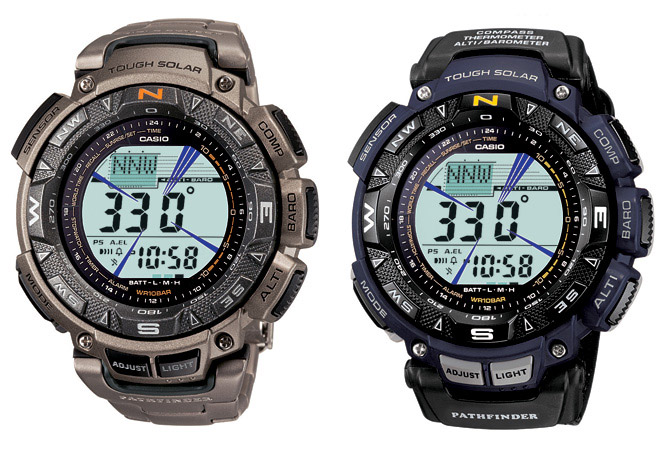
Getting back to the actual watch, it's a pretty normal Pathfinder -- the watch you grab when it's time to get outside. It works well as a daily wearer, but the 53mm width is a bit large for most of us at the office. That said, the display is super-large and thus easier to read, especially the time, altitude, compass bearing, or pressure displayed on the large center digits. The use of a second LCD layer for the compass is a treat, as you can see here, with north indicated by triple needles and the the other cardinal directions lit up, as well, for quick orientation. Simple and effective. The nearest-quadrant abbreviation (NNW shown here) is displayed as well, allowing both precise and approximate readings.

Yep, I immediately took it hiking! On the wrist, the three color scheme is not overly ostentatious, and of course the functionality and readability are excellent. I like the fact that day, date, month, year, and time are all visible at once, yet it's uncluttered and reads well.

Compared to the ultimate Pathfinder, the PAG40-7V lacks solar power, radio set, countdown timer, and moonphase/tides, but not much else. We still have the shrouded buttons, similar displays, and overall functionality at a fraction of the cost. The PAW1500T-7V is $350 or $400 for strap vs bracelet respectively; the PAG40-7V is $200. For half the price, you're getting more than half features, which seems like a good deal to me.

The strap is a standard Casio, meaning that it's custom to the watch, well-designed, and very comfortable. On the right, you can see the L-shaped attachments to the strap which keep it shaped for your wrist, and also that part of the 18mm thickness is a plastic layer on top of the stainless steel caseback.

Casio has long made excellent outdoor watches, and this one continues that tradition. They managed to reduce the price while retaining many of the features that made the Pathfinder so great. I thought that the lack of solar power would bother me, but in fact the only thing I really miss is the countdown timer which I find to be very useful for cooking, parking meters, and the like.

If you need a reliable, inexpensive hiking or everyday watch, give the PAG40-7V a look. Available this fall on Amazon.com only.

Our thanks to Casio PR for this review unit. Always appreciated!

posted under , | 1 Comments

Casio G-Shock GW-2000

Casio G-Shocks play many roles: fashion icons, hardcore tool watches, respectable divers, etc. Today, we look at something of a new phase for the G-Shock line in the form of a “multi role fighter.” The Casio G-Shock GW-2000 sports aviation styling while retaining the GMT features of many of its older siblings. The GW-2000 combines the radio controlled technology which Casio is now famous for with a refreshed style more reminiscent of the MR-G series.

Let's take a look at the details:
  • Mineral glass crystal.
  • 47mm at the widest point (wears more like 43mm).
  • 15m thick.
  • Radio controlled atomic calibrated module.
  • Solar powered.
  • Stopwatch with a resolution of 1/20th of a second.
  • 24-hour countdown timer.
  • Alarm.
  • Multiple timezones.
  • Perpetual calendar (with day and date).
  • Water-resistant to 200 meters (about 650 feet).
  • Neobright luminous paint.
The last multifunction watch I reviewed was the Citizen BL-5250 which shared some features with the GW-2000. Both watches are aviation style chronographs with alarms, chronographs, and solar powered movements. The GW-2000 adds world time tracking, shock resistance, and Casio’s excellent 6-band radio synchronized movement.

The model that we received came in full black with a bracelet fitted to a push button fold-over clasp. While the GW-2000 does wear smaller than its size would suggest, it's not a small watch; at 15mm thick, it is definitely a sport-oriented timepiece. But the GW-2000 is very light and easy to wear, and it's also available with a resin strap if you want to reduce the weight still further.

The GW-2000 comes in a standard G-Shock tin canister with a miniature users manual. Keep the manual handy; unless you have owned many G-Shocks, you will be referencing it as you get to know your new watch. Much like the BL-5250 and the Oceanus I had before it, freely moving between and activating features with reliable results takes a lot of practice. Any feature that requires the hands to move to a new reading (like the alarm) takes some time and a little patients. Additionally, the alarm is a little on the quiet side — it's sufficient, but it won't wake you from a deep slumber.

The nine o'clock subdial is the function/day indicator. To change features, you press the mode button, and it will cycle through the options which include day of the week, DST settings, alarm, and chronograph. This system takes some time to use properly, but you get used to it eventually. Using the second hand to select the city for the second time zone is simple enough, but I found it difficult to be sure that I was not changing my home time zone in the process. If you make frequent use of all these different features, you may prefer a model with a digital display (like the GW-2500 or the MTG-1500) as it makes navigation and configuration much easier.

The GW-2000 features a 6-band atomic synchronization system which uses radio signals from atomic clock broadcasts. These include clocks in the US, Japan, England, Germany, and China. This feature allows the watch to correct its timekeeping several times a day (or on deman), and is one of the features we like best about G-Shocks.

The most noticible feature of the the GW-2000 is the styling; much in line with the GW-2500, it is designed to be reminiscent of aviator watches and shares styling with Casio's flagship MR-G models (like the MRG-7500). The wide hour and minute hands make reading the time simple and remove much of the guesswork present in some of its thinner-handed predecessors. Additionally, the large "12" marker gives the GW-2000 a distinctive aviation look. This is a great improvement, and seeing as I normally wear dive watches, I felt right at home with the large hands. The luminous paint that Casio uses is called Neobright and can't quite keep up with the power of Superluminova (which is common on dive watches), but it's sufficient for something like this.

Combining the above features, the new styling, and 200m (650ft) water-resistance makes the GW-2000 an appealing sport watch that is light enough and suitable for most wrists (considering today's large-watch standards). The Casio GW-2000 is a great update to the GW lineup, and boasts an attractive $300 price range for the reviewed model. If the dual-display GW-2500 is not to your liking, the GW-2000 drops the additional LCD display but retains many of the features like radio controlled timekeeping, a light and comfortable bracelet, and the slick aviator styling.

posted under | 0 Comments

Rogue Warrior Red Cell GMT

Following hot on the heels of our review of the Rogue Warrior Avenger, let us introduce the Red Cell. Named after the unofficial title of Richard Marcinko's Navy security team, the Red Cell combines some interesting technology with a rough-and-tumble case and crystal guard.

Rogue Warrior is a new brand making hardcore watches for people who expect their watch to make it through just about anything. Rogue Warrior's tag line reads "When bad-ass is not bad ass enough." Is this simply marketing fluff, or is this a watch that sets a new standard in resilience?

Let's start with the specs:

  • Stainless steel case.
  • Japanese quartz movement with GMT hand.
  • 44mm wide.
  • 4mm anti-glare sapphire crystal.
  • Superluminova and Kryptolite illumination system.
  • Krypton gas filled case.
  • d3o shock absorbing system.
  • 3-year battery.
  • 20 ATM water resistance (200m/660ft).

The first thing that stands out about the Red Cell is its styling which is polarizing at best. It's definitely not a beautiful watch as the designers seemed to have made concessions in the aesthetics in attempt to make the watch as functional and resilient as possible.

The dial design is highly functional with both the standard hands and the GMT hand easily legible at a glance. The chapter ring and the GMT hand work together to keep track of a user defined timezone, and the hand is manipulated on the first pull position of the nicely knurled screw down crown.

The luminosity of the paint on the dial is excellent; Rogue Warrior uses Superluminova paint on the markers, numbers, and hands combined with Krypton gas which fills the case. The combination is called Kryptolite and allows the material to glow brightly and charge quickly. While it does work as well as the best Superluminova implementations I have seen, it does not seem to last as long as examples like the Seiko Monster -- a reasonable tradeoff, in my opinion. The Krypton gas in the case also works to prevent condensation from forming after drastic temperature or humidity changes.

The case is a stark combination of hard edges and those less-than-attractive crystal guards. When the overal goals of this watch are considered, picking on its looks begins to feel like comparing a tank to an italian sports car: they weren't designed with the same purpose (or buyers) in mind.

The case is very well finished for a watch at this price point. The edges are crisp, the sapphire crystal fits flush to the bezel, and the short strong lugs will suit a number of different strap options. The Red Cell certainly is heavy, but not in a cumbersome way, never feeling more weighty than most dive watches. Our test model was fitted to a digital camo leather strap, but the Red Cell can be optioned with a bracelet. The back of the case shows a gun and the acronym "W.G.M.A.T.A.T.S". To find out what that stands for, visit the FAQ section of Rogue Warrior's website.

Rogue-warrior-red-cell-lume The Red Cell definitely feels like it can take a beating, and if you happened to have read our review of the Rogue Warrior Avenger you will recall the incident that combined the Avenger with a tile floor from a considerable height. No serious damage, and the base functions of the watch were still perfectly intact. The Red Cell features d3o shock absorbing material that uses "intelligent molecules" to lock together and absorb the shock placed against the movement. The end result is a watch specifically designed to deal with the stresses of an active/dangerous lifestyle. Think: a tank for your wrist.

The Red Cell is available directly from the Rogue Warrior website and buyers can choose from a series of strap options. The Red Cell starts at $400, and given the market for tough military style watches and the technology seen in the Red Cell, that seems like a fair price. So whether you are a rogue warrior or just a weekend warrior, the Red Cell will likely keep ticking regardless of what you throw at it.

posted under , , | 0 Comments

Luminox SR-71 Blackbird 9052

If you like analog-digital watches, today's review might just make your day. This is the limited-edition Luminox SR-71 Blackbird, model #9052. Limited to 999 pieces, this seems to be their version of the Omega X-33. Let's start out with the specifications:

  • 44mm across, 50mm at the widest point, 15mm thick.
  • PVD-finished stainless steel case and bracelet.
  • Bracelet is three-link, solid, with solid end links, fliplock, and 23mm lugs.
  • Domed sapphire crystal with inner anti-reflective coating.
  • Inner dive bezel, operated by a screw-down crown at ten o'clock.
  • Tritium tubes on hours, bezel, and hands.
  • Reverse LCD display.
  • In an interesting twist: it also has an electronic compass.
  • Like the X-33, the caseback is a soundboard to increase the volume of the alarm.
  • Also like the X-33, the crown is actually a push button; rotating it has no effect.
  • 45 month battery.
  • ISA quartz movement.
  • Water resistant to 100m (330ft).
  • Three time zones, countdown timer, alarm, stopwatch, and my favorite: seconds-only mode.
As you can see from the profile, the Blackbird has quite a different appearance than the Luminox Blackout. It's tapered, subtle and considerably more understated. Take a close look at the bezel: it has a tapered profile that I quite like. The PVD finish is flat (non-glossy) which combines with the reverse LCD on the dial for a very stealthy look. You can also see in this picture how the lugs curve down around your wrist for a good fit. I did notice that when on bad pavement on a bicycle, the lugs dug in a bit due to the weight of the watch (175g), so I wouldn't recommend this as an exercise watch.

The Blackbird has some fascinating design decisions that I don't pretend to understand. For example, the inner bezel is set via the screw-down crown at ten o'clock; well and good. However, on your left wrist, it's quite tricky to operate, requiring removal. It's nice, but you probably won't use it much given that the watch has a digital stopwatch and countdown timer, anyway. The bezel does have a tritium marker, though, making it more useful at night.

Another oddity is the primary crown: as noted above, it's actually a button only, and unlike the bezel crown, it's not screwdown. I would have expected either a conventional button or a threaded crown. And lastly, there's no analog seconds hand. Seconds are displayed by a dedicated ring of segments on the outer edge of the display. It works, but I do miss the analog hand.

Here you can see the sounding board caseback design, very similar to the X-33. It's etched and inked with a very nice rendition of the SR-71 which, as an engineer and pilot myself, has always been one of my favorite planes. The alarm is good, though not as loud as the 80dB Omega. Luminox managed this compromise while still maintaining 100m water resistance, though, which is a good tradeoff and a strong point in their favor.

The face and dial are, in contrast to the Raptor just reviewed, quite sparse and understated. Stark white hands, minimal text and graphics, and a reverse LCD display; it all adds up to outstanding legibility. The sapphire crystal -- minimally domed with an inner camber and inner A/R coating -- also helps quite a bit. And, of course, at night the tritium tubes rock. Note, however, that the digital portion is not backlit, and therefore not useable in the dark.

The watch has some really unusual features you might enjoy like the compass, and the "week of year" and tachymeter modes. I like that you can select a display mode that suits you: time, full date (day/date/year/month), seconds only (very clean), time, second or third timezone, alarm or countdown timer. It's an extremely functional watch, and as with the X-33, the large curved segments are easy to read and use. The buttons and pushbutton crown are well-sized and spaced, and work fine even with gloves on; that's one advantage for the crown design.

Case and packaging are quite good; it comes in a very nice travel pack with padding and cleaning cloth that you can actually use as opposed to something you store on a shelf or discard. It also has internal pockets to hold the manual and warranty card -- another thoughtful touch.

The bracelet is good and fully PVD coated, including the inside bits of the clasp. It has snap closure, fliplock, four micro-adjustments, solid links with pins, and solid end links -- a good match for the watch, and with standard lugs on the case so you could try your own strap if you want. I suspect it would work well with a dark leather strap, as well.

ClaspOn the wrist, this is a fun watch to wear: substantial, but not massive, uniquely styled, and tremendously legible day or night. The sculpted bezel and profile mean that it's more cuff-friendly than you might expect which is one more thing to like about the design.

List price on the Blackbird is $1,500, consistent with Luminox's recent push into higher-end watches. For a watch that compares well to the X-33, that seems like a reasonable price, especially given the discounts usually available, and how much easier the Luminox will be to find.

If you like analog-digital watches as much as I do, this one is a clear winner: more waterproof than the X-33, tritium illumination, good alarm, tons of functions, cool inner bezel, cuff-friendly profile, and a clean, understated dial.

Our thanks to Luminox USA for the review loan.

posted under | 1 Comments

Casio PAW2000T-7V "Slim Pathfinder"

Every new Pathfinder I get tends to become my favorite, and the PAW2000T-7V is no exception. In fact, not only has it become my favorite Pathfinder, but it is also one of my favorite digital watches in general. I've typically thought of Pathfinders purely as outdoors watches in the past — watches you only wear while hiking, boating, stargazing, etc. — since all the features they pack have traditionally required large, knobby cases to accommodate sensors and circuit boards. But not so with PAW2000T-7V. Although still obviously a feature-rich digital watch, the PAW2000T-7V is the thinnest, cleanest, and most subtle Pathfinder I've ever owned.

The PAW2000T-7V shares a very similar set of features with the PAW1500T-7V we recently reviewed with the following exceptions:

  • The PAW2000T-7V is water-resistant to 100 meters (330 feet) rather than 200 meters (660 feet). Although more is usually better when it comes to water-resistance, 100 meters is more than enough for anything but diving.
  • The PAW2000T-7V doesn't have the moon or tide graphs that make the PAW1500T unique, however in exchange, it does some other interesting tricks.
  • The digital compass on the PAW2000T uses a transparent LCD to overlay direction indicators over the entire face of the watch with numerical bearing information displayed underneath. The PAW1500, on the other hand, uses small squares around the parameter of the main LCD (see the photo album for pictures of the compass in action).
  • The PAW2000T-7V has an additional Sunrise/Sunset Mode which lets you check sunrise and sunset times for any location on any date. In addition to the raw data, the PAW2000T uses the compass LCD overlay to chart not just sunrise and sunset times, but also the current time relative to the two (see the photo album for a visual). This is really a fantastic addition to the Pathfinder feature set.
The differences outlined above should help you decide between the PAW1500T and the PAW2000T, but there's one more thing to take into consideration: size. The PAW2000T is about 2.5 millimeters thinner than the PAW1500T. 2.5 millimeters may not seem like much, but in the context of a watch case, it's significant. So significant, in fact, that I've found the PAW2000T to be the first Pathfinder that doesn't overwhelm my paltry 6.5" wrist, and can easily be worn daily as both a fantastic outdoors tool, and an easy-to-read, lightweight, nice-looking, hugely functional timepiece. In other words, the size and form factor of the PAW2000T is a feature in and of itself, and one I'll be very reluctant to give up in future models.

posted under | 0 Comments

Review For Victorinox Classic XLS MT

As a former pilot, there are two watches that represent the absolute finest gear for flying: the Omega X-33, and Breitling Aerospace. Both are quartz and analog/digital, and have very different looks. Today's post is about a very similar watch that has a much more reasonable price tag to the Aerospace, the Victorinox Swiss Army Classic XLS MT. I've not yet confirmed this, but I strongly suspect that it has the exact same movement as the Aerospace, the ETA 988.432, making it one heck of a deal. Specifications of the Victorinox are:

* Swiss made, Swiss quartz movement.
* Anti-reflective-coated sapphire crystal.
* Stainless steel case, PVD-coated 'gunmetal'.
* Luminous hands and hour markers.
* Crown guard.
* Countdown timer, alarm clock, stopwatch, dual time zone, multiple languages.
* Water resistant to 100m.
* 45mm by 12m, quite large.

List price is shown as $1,095USD, but I would expect a discount from that. Let's compare to the Breitling Aerospace:

* Titanium case.
* Night-vision-goggle-compatible backlight. (I have no idea what that means, but it sure sounds cool.)
* Second timezone, alarm, stopwatch, countdown timer.
* Crown-driven operation.
* 100m waterproof.
* AR-coated sapphire crystal.
* 42mm by 10.4mm, 38g.

Picture_1(Picture snipped from the Breitling website)

You can kind of see from the pictures that the displays are identical, which makes sense if the movements are the same. You can also see that the Victorinox is larger. 45mm is large but not huge; I'd be happy to wear one.

As with many Swiss brands, Breitling bars selling over the Internet, but Amazon sells them with a list price of $2,795.

There are two things I dislike about this movement: the lack of a second hand (useful for 30-second turns), and the crown-driven operation. It's really hard to manipulate while wearing it, which limits the functionality a bit. Nevertheless, I'm hoping that I can try the Victorinox, as that price is much more up my alley, and I really like how it looks.

http://www.watchreport.com/

posted under , | 9 Comments

Casio Edifice EQW-M1000DB-1ACR

Today's review is of the Casio Edifice EQW-M1000DB-1ACR, introduced at Basel 2009. It's a multifunction analog quartz watch with an unusual dial.

Specifications:
  • Six-band atomic set (Japan, US, UK, Germany and China - state of the art).
  • Tough solar power. This is Casio's G-Shock technology, meaning its shock-resistant solar power with a rechargeable battery.
  • Five motors driving the various hands and dials.
  • World time (29 cities, as seen around the chapter ring).
  • Daily alarm.
  • 1/20th of a second stopwatch.
  • Countdown timer.
  • PVD-plated tachemeter bezel.
  • Stainless steel case, and solid-link bracelet with push release.
  • Mineral crystal.
In my opinion, this watch represents Casio's competition to the Oceanus models. It's got a very similar feature set and a list price of $450. What sets it apart immediately is the striking two-level dial. As you can see, the lower left portion is about 3mm lower than the rest, showing an asymmetric 24-hour dial that mostly looks cool. It also resembles the structure of a balance wheel in a mechanical watch, which I suspect was deliberate. The upper dial level is translucent, showing a bit of the under-structure, and the overall effect is pleasant and intriguing.

There are several design touches around the dial to note: the applied hour markers at 2, 4, 8 and 10 o'clock that resemble slotted screw heads, the nice even PVD finish on the contrasting bezel, the unusual use of a marker-on-dial for the indicator at 10 o'clock, and the deeply inset 24-hour dial at 2 o'clock. A lot of thought and effort went into how the watch presents, which is something you'll appreciate as you wear it long-term.

In terms of function, this Casio is, as you'd expect, a laundry list of awesome. No one does quartz like Casio, Citizen, and Seiko -- as of this posting there isn't another manufacture that has radio-reception, solar and multi-motor analog. The triple play of solar, atomic, and quartz means that you never have to change the battery, never have to set the time, and never have to sweat when daylight savings takes effect. OK, you might need to if you're outside radio reception. However, six-band receive means that even less of the Earth is in that category. Rounding out the feature list with alarm and countdown means there's nothing to miss here.

I think Casio aimed this watch at someone who travels and wants a single watch. It straddles the border between dressy and sporty quite well; I consider it unobtrusive in both settings. The low-profile shape and sleek bezel let it slip without effort under dress shirts, and the stainless steel and 100m (330ft) water resistance mean it's good for everything short of a full SCUBA dive. The bracelet is solid, comfortable, and has a simple two-button side release, which lacks the flip lock of more sporty watches. Since it has standard lugs, you can also change it out for a strap if you like. Given the dial complexity, the hands are easy to read at a glance. The dark red seconds hand also presents a nice bit of color without being too obvious. The 2 o'clock dial, used for the second time zone, countdown timer and stopwatch, is a bit small to read precisely, so if you really need exact timing, you might be better off with a digital dial. The dial indicator at 10 o'clock spins once per second in stopwatch mode, making a interesting whirl of light from the grooves before stopping after one minute elapses. (When you stop the stopwatch, it spins to the final reading.) Weight is reasonable at 160g, and the watch is well-balanced by the mass of the bracelet.Left-side

From the sides, you can see the button guards and buttons. The right-side button has the Casio logo on it -- a nice touch.

Overall, this is an excellent maintenance-free watch for those who want a bit of style without trying to show off. The 3D dial gives you something to appreciate in a unique style, and the solid Casio movement means never having to worry about the timekeeping. The list price of $450 is good value, and you can probably find it online for even less. Casio for the win!Bracelet-and-back

Our thanks to Casio PR for the loan of this review unit. Much appreciated.
Article Source : http://www.watchreport.com/

posted under , | 0 Comments

Seiko goes global with Ananta

One of the frustrations of being a Seiko fan is that many of their finest watches are only released to the Japanese domestic market. At this year's Basel watch fair, Seiko announced the global release of more models under a new line called Ananta. Described as "an exclusive collection of luxury timepieces with Spring Drive and high-grade mechanical movements, targeted at those who truly understand and appreciate fine watchmaking."

Ananta includes both high-grade mechanical as well as SpringDrive watches, giving us Seiko fans ample material for appreciation. Look for more posts here as we learn more.

From reading the press release and reviews by attendees, the other big news on Ananta is the new steel process that they invented for it. Based on processes used in making katana swords, the finish is incredibly even and mirror-like. I can't wait to see one in person. As you can see from the images below, they also used the curve of the katana as inspiration for the rotor notches above and the sides of this case:
Very promising indeed. We look forward to learning more.
Article Source : http://www.watchreport.com

posted under , | 0 Comments

Reviewing the Orbita Watch Winder

Looking for the ideal winder automatic watch to meet your requirements can be as simple as researching your choices. How much is your watch really worth when you consider it in terms of both money as well as sentimental value? Would you rather have a plain functional storage unit or a sophisticated display case with all possible features? These are the kind of questions you have to ask yourself before you decide on an Orbita watch winder or one of any other make.

The Orbita watch winder which is manufactured in the Unites States is said to be one of the best watch winders available. It can be set to move at various turns per day starting from 500 and going up to even 950. This brand in particular has an auto-reverse feature and a battery which has a life ranging from six to twenty four months. The Orbita watch winder is one of the less costly models and run quietly without over winding automatic watches. The Orbita watch winder comes in the single, dual and multiple heads to house more than one piece at a time and each can be programmed for a different number of turns per day.

The high-priced Rolex too has a wide range of winder automatic watch available. These watch winders come in a great variety starting from the simple ones to elegantly designed and elaborate ones. Most of their models can hold from one to ten watches at a time in a box. It is proposed that if you are not sure about the certain brand of watch winders you should opt for, you should take the assistance of a watch expert or jeweler to narrow down your search.

The winder automatic watch also comes in three different ways of winding – clockwise, anti-clockwise of bi-directionally. Some products even have an option to let it sleep as it is required if you are to simulate the normal wear if a person was wearing it; that is the winding and then unwinding. Continuous over winding can lead to damage of your precious watch. Then you have other models of the winder automatic watch which let you wind the watch clockwise for half an hour, then anti-clockwise for the next half hour followed by a three hour rest thereafter. This is desirable as continuous winding can damage the watch.

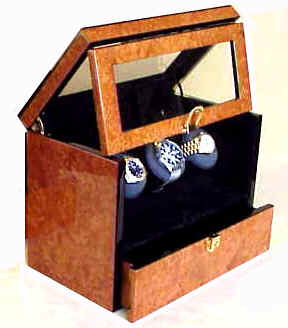
You can find a lot of other winder automatic watch makes which are a favorite among watch collectors. Like the top brands, they are beautifully made with accurate engineering. Designed to delicately, gradually and steadily wind your watch, the Orbita watch winder makes sure that your watch is well wound and ready to wear when you choose to. Some of the watch winders come with a glass front so you can see the time pieces and at the same time keep it protected from dust. Some of the watch winders can hold even four watches at a time and the motor doesn’t really make any sound.
Article Source: http://www.articlesbase.com/

posted under | 1 Comments

Selling Swiss Army Watches

One of the more popular items sold on online auction sites are Swiss army watches. These watches are well-known for being reliable and difficult to break. They can be worn underwater and under extreme heat conditions. Selling these watches is a good way to earn a steady income. When displaying a Swiss army watch, be sure to photograph it from many angles. This will give the buyer an opportunity to see the watch and decide if they want to buy it. Always offer as much information as possible. This will also catch the buyers attention. The desired effect is a bidding war between two or more buyers. This will raise the asking price which will make a person more money. Making a valuable item seem even more valuable by providing pictures and details will hopefully cause buyers to bid more money.

Selling swiss army watches online requires a person to be able to write descriptions of the watches that are better than their competitors. Many people sell these watches. Being able to offer many different styles with descriptions that will make people bid will sell more merchandise. Having styles of swiss army watches that other sellers do not have will also keep people coming back to place bids. Collectors of these watches will visit many sites throughout the day. The more varieties a person can offer, the more business they will be conducting which will make them more money. A full online store is a store that will make money.

Sellers find Swiss army watches at garage sales, auctions, and through ads placed in newspapers. They will even buy from other online vendors. It is important to be honest about products that one would like to sell online. If a watch is scratched, the buyer must be told about it. Chances are, they will still choose to bid on the watch. If not, there will be others who will not have a problem with a scratch. If a person does not inform a buyer about a scratch, the seller is subject to a poor rating which could destroy his business. People are willing to pay lots of money for Swiss army watches whether or not they are deformed in any way. Knowing in advance the kind of merchandise they are bidding on will determine how much they are willing to bid. Online auction sites, though very large, are still small enough for people to make judgments about sellers. Buyers talk to each other will warn others about dishonest behavior. Selling watches honestly will keep a person in business for many years. There is nothing wrong with making a product look as good as possible, as long as they are honest about any defects that may be present.
Article Source: http://www.articlesbase.com/

posted under , | 0 Comments

Reviewing the Orbita Watch Winder

Looking for the ideal winder automatic watch to meet your requirements can be as simple as researching your choices. How much is your watch really worth when you consider it in terms of both money as well as sentimental value? Would you rather have a plain functional storage unit or a sophisticated display case with all possible features? These are the kind of questions you have to ask yourself before you decide on an Orbita watch winder or one of any other make.

The Orbita watch winder which is manufactured in the Unites States is said to be one of the best watch winders available. It can be set to move at various turns per day starting from 500 and going up to even 950. This brand in particular has an auto-reverse feature and a battery which has a life ranging from six to twenty four months. The Orbita watch winder is one of the less costly models and run quietly without over winding automatic watches. The Orbita watch winder comes in the single, dual and multiple heads to house more than one piece at a time and each can be programmed for a different number of turns per day.

The high-priced Rolex too has a wide range of winder automatic watch available. These watch winders come in a great variety starting from the simple ones to elegantly designed and elaborate ones. Most of their models can hold from one to ten watches at a time in a box. It is proposed that if you are not sure about the certain brand of watch winders you should opt for, you should take the assistance of a watch expert or jeweler to narrow down your search.

The winder automatic watch also comes in three different ways of winding – clockwise, anti-clockwise of bi-directionally. Some products even have an option to let it sleep as it is required if you are to simulate the normal wear if a person was wearing it; that is the winding and then unwinding. Continuous over winding can lead to damage of your precious watch. Then you have other models of the winder automatic watch which let you wind the watch clockwise for half an hour, then anti-clockwise for the next half hour followed by a three hour rest thereafter. This is desirable as continuous winding can damage the watch.

You can find a lot of other winder automatic watch makes which are a favorite among watch collectors. Like the top brands, they are beautifully made with accurate engineering. Designed to delicately, gradually and steadily wind your watch, the Orbita watch winder makes sure that your watch is well wound and ready to wear when you choose to. Some of the watch winders come with a glass front so you can see the time pieces and at the same time keep it protected from dust. Some of the watch winders can hold even four watches at a time and the motor doesn’t really make any sound.
Article Source: http://www.articlesbase.com/

posted under | 3 Comments

Casio WVA-105HDE-1AVER

Today, our review product Came From Casio WVA-105HDE-1AVER. An elegant wrist watch that maybe you will receive or buy it.
This watch has silver color with the specified :

  • EL Backlight
    An electro-luminescent panel causes the entire face to glow for easy reading. Includes an After-Glow feature that keeps the EL backlight turned on for a few seconds after the light button is released.
  • DCF/MSF Radio Signal Receiver
    A built-in radio signal receiver ensures that the exact time is displayed across much of Europe. Watches with this symbol can pick up radio signals from Germany and the UK.
  • Time Memory 30
    At the press of the button, the current time and date are frozen and stored. Then you can exactly log the start and finish of a project, for example. The memory can store up to 30 entries.
  • World Time
    Displays the current time in major cities and specific areas around the world.
  • Date Alert
    A mark appears on the display when a preset date is reached.
  • Stopwatch function (1/100 - 1HR)
    Elapsed time, split time and final time are measured with 1/100-sec accuracy. The watch can measure times of up to 1 hour.
  • 5 Daily Alarms
    The daily alarm reminds you about recurring events with an acoustic signal at the time you have set. You can also activate hourly time signal that indicates each full hour. This model has 5 independent alarms for flexible reminders of important appointments.
  • Snooze Feature
    Each time you stop the alarm, it sounds again after a few minutes.
  • 2 Years - 1 Battery
    One battery will supply your watch with the power it needs for about 2 years.
  • Full Auto Calendar
    Allowances are made automatically for months of different lengths, in case date corrections for leap years are required.
  • 12/24-hour Timekeeping
    Times can be displayed in either a 12-hour or 24-hour format.
  • Spherical Glass
    The surface of the glass is rounded. So you will look as a simple personality
  • Resin Case
    Stainless Steel Band, it' wouldn't break or scratch.
  • Safety Catch
    Always reliable: This watch has a particularly secure safety catch, which helps prevent the strap from opening by mistake.
  • Water resistance classification (5 bar / 50m)
    This watch can be worn when showering and bathing - it is tested for water resistance up to 5 bar / 50 metres. The metres value does not relate to a diving depth but to the air pressure used in the course of the water resistance test. (ISO 2281)
  • Type of battery
    CR1620. The type of battery that will keep your motor life about 2 years
  • Dimensions
    approx. 56mm x 41,4mm x 13,3mm (H x W x D)
  • Weight
    approx. 88 g

posted under , | 0 Comments

The Watch Winder is a Great Invention

Our greatest inventors have produced improved technology to let the people of the world stay on time. This new generation of time pieces or automatic watches make use of an altogether different system to keep watches wound and working. There are plenty of automatic watches with the most modern designs which don’t require manual winding at repeated intervals of time. Such watches actually run on the motion of the wearer’s wrist or arm as he or she goes about their daily chores. The only problem comes when the watch is left on the dresser and not worn for whatever reason. When this happens, the watch stops for an indefinite period of time. Although it might be possible to wind these watches manually, watch winders are the best solution. You can choose from Orbita watch winders besides plenty other makes.

The main rule of functionality is that the watch winder mimics the motion of a regular wearer by moving the watch in a round pattern. The Orbita watch winders or any other are designed in such a way that they will not wind up the watch more than is absolutely required or as much as will damage it. Most of the watches available today that wind up automatically when the owner uses them require a motion lasting about half an hour per day and the watch winder can easily satisfy this need.

If you want to be sure about the superiority of the watch winder you are on the verge of purchasing, try to look into its internal capabilities. The winder should give you complete control and automation with the help of an internal circuit; in other words it should not need to be turned on or off manually. It should also have the ‘Turn and Rest’ function so that the motor stops after a cycle of rotations in order to mimic the movement of the wrist which is not moving constantly. Over-winding the watch is risky and can shorten the life of the components within.

The appearance of the watch winder too is important. The watch winder case or box functions doubly as a winder as well as a storage medium for your precious watch. So the watch winder box or case should not only protect the watch from the environment but also give a great look. There is a wide variety of Orbita watch winders available on the web, ranging from the classical and sophisticated ones made of wood, leather and glass to the even more modern and stylish ones.

Lastly, before you purchase one of the Orbita watch winders or any other make of watch winder for that matter, decide on the budget for this purchase. It is better that you invest a little more and buy a good quality product rather than a cheap product that might damage your precious watch. You can also find the perfect automatic watch winder by searching the Net. It is not only simpler, consumes less time but will also save you some money as compared to consulting a jeweler perhaps.
Article Source: http://www.articlesbase.com/

posted under | 0 Comments
Older Posts Home

Followers


Recent Comments